Monday, June 17, 2013

SUPERMAN (1978, 1980, 2006)


SUPERMAN (1978, USA, Richard Donner, screenplay Mario Puzo, David & Leslie Newman, Robert Benton, Tom Mankiewicz)
SUPERMAN II (1980, USA, Richard Lester & Richard Donner, screenplay Mario Puzo, David & Leslie Newman, Tom Mankiewicz)
SUPERMAN RETURNS (2006, USA, Bryan Singer, Michael Dougherty & Dan Harris)

Even though you've been raised as a human being, you are not one of them…. It is now time for you to rejoin your new world and to serve its collective humanity. Live as one of them, and discover where your strength and power are needed… They can be a great people, Kal‑El. They only lack the light to show the way. For this reason above all — their capacity for good — I have sent them you. My only son.

Battles rage, wars are waged over whether SUPERMAN RETURNS is a worthy successor to its predecessors. Over where the franchise went wrong, over who was the best Lois Lane or Lex Luthor, over whether Supe is a Christ figure, or whether he's a worthy one, or whether it matters. Over whether SUPERMAN and its sequels and siblings saved a foundering seventies film industry, or whether the adolescent adventure blockbusters from the Whiz-Bang kids (Lucas, Spielberg, Donner et al) were commercial kryptonite to the golden age (or would it be a silver age? I can never keep such matters straight) of seventies auteurism (Scorsese, Coppola, Schrader et Altman). I'm inclined toward a third theory: that the seventies were an abysmal time for movie-goers, that apart from the occasional masterpiece there wasn't much on the big screen that you'd want to watch any given week, but that as refreshing as Supe, Indie and Skywalker's gang may have been, they also resuscitated a dying studio system whose resurrection was mostly bad news for good movies. You can pick your own myth.

What's obvious about this new generation of nostalgia-tinged adventure flicks is that they were just plain fun: they didn't take themselves too seriously, they lasted longer than a theme park ride and you didn't have to travel to Orange County to get your thrill. What's maybe not so obvious is that all three of the fin de seventies "Just A Movie" franchises offered audiences something more than just a movie. Along with thrills and chills and good triumphing over evil (in morally ambivalent times), they offered – or tried to offer, or could be interpreted as offering – Faith. Transcendence. God.

It had been a long, long time since Christians had found much at the movies that connected with their faith. Not since the Good Priest movies of the forties or the Bible Blockbusters of the fifties had the silver screen reflected much Light. Cinematic dreamers dream the dreams of their culture (check out David Mamet's Writing In Restaurants for more on this), and for a couple decades there our collective consciousness had pretty much decided God was dead, or at least too boring to be in a movie. Christians who loved the movies and yearned to see some sort of onscreen representation of their faith – or any sort of faith – had to gain what soul sustenance they could from dour and doubting Europeans. Christian film books pretty much orbited around Bergman, Bresson, Fellini and Dreyer (how could they miss Rossellini?), or settled for spelunking for moral nuggets deep beneath the surface of Oscar-contending American fare.

Maybe that's why we all seized so hard on what Robert Short called The Gospel From Outer Space. Suddenly, from the place we least expected it, there was all this religious stuff. Righteous quests, spiritual mentors, mysticism and transcendence, the affirmation that there might be something higher than cold rationalism and reductive science. Christ figures even! The coolest movies out there, the ones everybody wanted to see, also carried this secret (or not so secret) message, and if you knew how to decode it, the right answer was… God!

Somehow it was validation. It was like finding out the most popular kid in your high school was a Christian! So maybe you weren't such a geek after all.

I think something like that accounts for the immense amount of attention these movies attracted in religious circles in their day – and for the rather underwhelming spiritual significance that's apparent when when you re-examine them today, in a time when religious faith is once again permissible onscreen. You'll find people (guys, usually: they were between ten and twenty when their favourite came out, probably while they were going to a Christian school) who spin elaborate theologies out of the Star Wars or Indiana Jones or Superman movies, and as interesting as their arcane and intricate and well-supported theories may be, you can't help feeling the case is being over-argued: the movies weren't as good as they're certain they are, and the spiritual import of the stories isn't all they crack it up to be. The rest of their tastes have grown up, they've discovered Kieslowski and Kurosawa and Kaurismaki, but when the talk turns to Quasi-Spiritual Blockbusters Of The Late Seventies, the perspective shifts. They take on the unreasoning (or over-reasoned) intensity of benign conspiracy theorists. They've seen these films more times than they've read the gospel of John. And that's saying something.

No doubt they're onto something. In the original SUPERMAN film, when his father sends baby Kal-El away from the dying planet of Krypton, Dad's blessing has undeniable Johannine overtones: "You will carry me inside you all the days of your life… The son becomes the father, and the father the son." Discovering an apparently abandoned toddler near a meteorite crater, Ma Kent speaks of her prayers that "the Good Lord would see fit to give us a child," and when young Clark comes of age he leaves his earthly family behind to head into the wilderness and learn his true nature. At thirty, in obedience to the words of his heavenly father, he goes out into the world "to serve its collective humanity." In the words of Jor-El (echoed in the series-reviving SUPERMAN RETURNS , which makes a point of taking up and embellishing the orginal film's Christological imagery), "They can be a great people. They only lack the light to show the way. For this reason above all I have sent them you. My only son." (Woulda been better with "only-begotten son, but whatever…)

It's at this point – a full fifty minutes into the story – that SUPERMAN: THE MOVIE goes suddenly astray. In the portrayal of Superman's origins, on the dying planet Krypton and in the Kansas cornfields, there is a commitment to evoking the mythos of the original DC comics, being faithful to a context in which the sheer goodness (and even, perhaps, the Goodness) of the hero rings true, in which the mythic themes resonate, in which simple heroism can carry the day. But when Our Hero hits the big city and encounters Real Evil – a guy stealing a tomato? wacky newsroom types unsure how to spell "massacre" and "rapist"? – the film descends to corn and camp, and for this viewer at least, its capacity to stir the soul is lost. Some appreciate Christopher Reeves' penchant for physical comedy: it struck me as embarassing and, as much fun as Gene Hackman is sneering his way through Lex Luthor (splendidly reprised by the impeccably-cast Kevin Spacey in the 2006 revival, though with a nastier edge), the whole tone increasingly veers into the kind of dismissive camp I knew enough to hate when the Batman TV series did the same to my other DC hero – when I was only nine! Fans of the films protest when less-than-fans say these movies are "for kids," but can they really deny that much of the writing here is utterly juvenile? From Clark's goofball act to the smirking "dirty joke" tone of Lois and Clark's first date to her unbearably mawkish monologue as Superman takes her flying ("Do you know what it is that you do to me? Holding hands with a god, quivering like a little girl shivering, you can see right through me, wondering why you are all the wonderful things you are…"), it's really embarassing and juvenile. Sorry.

SUPERMAN 2 compounds these sins. In an attempt, I suppose, to make the too-good-for-the-times Superman "a guy we can all relate to," a situation is contrived for the no-longer-quite-so-super man to sleep with Lois – hey,everybody was doing it – and the whole Messiah Of Steel thing has pretty much fizzled away to nothing. The mighty had well and truly fallen, unadulterated goodness trumped by good old adultery. How disappointing.

Two more sequels followed, each lacking more lustre than its predecessors, and for a couple decades it seemed Superman was deader even than God – who, incidentally, was making something of a comeback at the cineplex in the absence of the Krypton Christ. Which in turn may have prepared the way for Bryan Singer's re-theologized franchise-resurrecting SUPERMAN RETURNS in 2006.

Singer and his writers pay tribute to the 1978 original with abundant (some would say overly abundant) references and riffs while dialling down on the camp and picking up on the Christ. When Superman returns to earth after a five year absence seeking his father's home planet, Ma Kent cradles him in her arms in an obvious pieta image. Lois has won her Pulitzer Prize but lost her hope, writing an acclaimed article "Why The World Doesn't Need Superman," telling her live-in partner "The world doesn't need a saviour, and neither do I."

But this film is convinced that, actually, she does, and it goes an extra mile or two to polish up this particular Superman into something closer to the image and likeness of a savior. Superman responds directly to Lois's cynicism: "You say the world doesn't need a saviour, but every day I hear them crying for one." In the film's most affecting image, a world-worn Superman flies high above the earth to surrender himself to the life-restoring light of the sun, then to listen to the sounds of human life rising up like prayers to his all-hearing ears: at the sound of evil or suffering, he soars back earthward to bring at least a limited sort of salvation.

Like the earlier films, this one also goes some way toward putting human flesh on the man of steel, and for some reason I appreciated the way that theme was handled here in pretty much exact inverse proportion to how I felt about it in the earlier films. Clark/Supe is clearly in love with Lois (and far more convincingly: Clark isn't so pre-adolescent goofy, and Lois loses her shrill and salivating silliness), but he's kept from inserting himself back into her life by the fact that she's got a pretty good relationship with a pretty decent guy, who's being a not-too-bad stand-in father and provider for the child Supe/Clark fathered in that previous one-night-stand. (Yup, in the new Superman moral universe, even those sorts of actions have consequences.) In his loneliness, he yields to temptation and uses his super-powers to watch and listen in on what he shouldn't - not to leer through Lois's clothes (as every teenaged Superman reader fantasized, and the earlier films toyed with) but simply to watch her leave in an elevator (a gorgeous bit of filming), or to torment himself by eavesdropping on a scene of peaceful domesticity with Lois's new family. The earlier film told us Kal-El would be isolated and alone: this film shows us that, let's us experience it at least a little bit.

But still. What sort of Messiah is this Man Of Steel? In even the best of these films (whichever you might personally prefer), or in the Superman uber-myth that overarches them all? How much of a saviour is Superman?

Maybe not much of one. For starters, there's a big difference between saving somebody dangling from the edge of a building, or even a planeload of somebodies hurtling toward their mortal destruction, and doing anything about anybody's immortal souls. I suppose that's self-evident, and everybody knows that even at their most intentional superhero movies would never claim to have anything more than a parabolic, metaphoric resonance with bigger, realer stories of salvation. But this 1979 Newsweek points up a potential problem with that sort of thinking;
People can croak "Entertainment! Entertainment!" until they're blue in the face. The fact remains that films like CLOSE ENCOUNTERS OF THE THIRD KIND, SUPERMAN, and even STAR WARS have become jerry-built substitutes for the great myths and rituals of belief, hope and redemption that cultures used to shape before mass secular society took over.
In settling for heroes who offer only salvation from physical danger, in conflating invented, simplistic earth-bound myths of strong men coming to the rescue with truer, eternal myths of redemption through sacrifice, the kind of strength that's only shown in weakness and surrender, do we subtly lose track of those essential truths, swapping them for something that's a pretty cheap substitute?

In 1983, Robert Short drew out the nervous-making resonances between Neitzsche's superman and the more familiar guy in the cape and tights, going on to point out how different either were from the Guy from the sky the latter sought to invoke: "There is a significan resemblance of Superman to Christ in the man part. But an essential difference is in the super….
Jesus was very cautious in using the 'super-powers' of his Father, although he obviously could have at any time. "Do you think that I cannot appeal to my Father, and he will at once send me more than twelve legions of angels?"… Why did Christ generally refrain from this kind of outwardly obvious use of supernatural power?
Short points out not only that Jesus avoided offering signs or proofs of his divinity in order to put the focus on who he was and what he taught, but also that
Christ doesn't let us off so easily: he rejected the role of a superman… He was a humble rabbi, a meek and lowly shepherd, the carpenter's son, whose mother and brothers and sisters the people also knew. To believe in this man requires a radically deep sacrifice on our parts… God did not send our Savior to us in the form of a superman, but rather in the form of a servantman, a lowly man of sorrows who finally would not even save himself from the torment, the humiliation, the death, of the cross.

To be fair, as sharp a commentator as Roy Anker is quite content to delight in the incarnational resonances he finds in SUPERMAN without building an entire (and misguided) theology on them. In his very fine book Catching Light: Looking for God in the Movies, he identifies this as "a Jesus story – significantly, not the Jesus story," and demonstrates how "the shape and substance of these contemporary religious fables" fits them quite specifically into Catholic film scholar Neil Hurley's designation of "christomorphic" fiction (which Hurley developed from the work of Theodore Ziolkowski). Citing films that range from John Ford's THE FUGITIVE or Bresson's DIARY OF A COUNTRY PRIEST to Ken Russell's TOMMY and Rosenberg's COOL HAND LUKE, Hurley identifies and finds value in a specific type of film by considering "formal patterns of resemblance and not…the theological substance of the life of Jesus as we find it in its exemplary expression in the gospels."

Anker in turn brings considerable skills as an interpreter of literature to his exploration of this particular film franchise, and if we disagree about Christopher Reeve's "splendid physical acting and nuanced manipulation of voice and face" or Anker's assertion that Superman's first public miracle "is perhaps the finest comic moment in a golden age of American film, 1970s cinema," it's nevertheless a pleasure to bask in this erudite (and theologically sophisticated) writer's detailed enthusiasm for a favorite flick:
The whole of the film serves to elucidate and impart the surprise, wonder, and delight of the fantastic possibility of an incarnation of divine love itself… no simple miracle-working trickster in a cape or spider webs but a notion of God that features an extravagantly loving servant who comes out of nowhere to suffer and triumph for bedraggled human creatures. To the filmmakers' credit, they do indeed, in Frederick Buechner's words, "get the joke," the high humor of the Incarnation, "the hilarious unexpectedness" of the impossible actually happening.

But if we're going to haul in Roy Anker as a witness for the defence, we need to consider consider the estimable Robert Jewett for the prosecution: he's got real problems with Superman and all his buddies. In Captain America and the Crusade Against Evil and The Myth of the American Superhero, co-written with John Shelton Lawrence, the boys go kinda easy on Supe while finding the whole American fixation on superheroes the root of all kinds of evil. You'll think they're nothing but kill-joys when I tell you they don't like the fascist politics and spirituality of STAR WARS (huh? what?). But you know? They make a lot of sense. They see Superman as the pivotal dude, the guy who added "super" to the earlier vigilante heroes of Lone Ranger ilk, and led to the proliferation of an anti-democratic, counter-Christian monomyth where leaders are always weak or corrupt, the community helpless and truth and justice entirely in the hands of the lone, zealous outsider who overcomes evil with violence – a distinctly American "pop fascism." Shame on you, Shane! (I'd be curious to know what Bob and John think of SUPERMAN RETURNS, where some just plain folks actually do follow the hero's lead and get heroic themselves, filling in the part of the job that the man of steel can't quite manage on his own.)

So anyhow, that's SUPERMAN, weighed and wanting. Look for too much theology and you run into trouble. Supe just ain't that great a Christ figure, and his movies just ain't that great either. These are pretty slight cinematic fare, and their underdeveloped Christ The Kick-Butt Rescuer theology isn't really going to feed anybody's soul, won't sustain for the long journey.

Or will it? Because, having said that, it still feels like there's something there, and to dismiss these movies out of hand would be to dismiss something this story (in its many incarnations) actually does manage to get right, at least in its better moments.

Maybe it just comes down to this. For all the times the movies fumbled it, for all the ways the Supe-as-Saviour metaphor falls short, for all that other superheroes may be more complex or more conflicted or more human or more identifiable-with-in-their-human-fallenness… I think this contributor to the Arts & Faith conversation (he goes by CrimsonLine) got it right: "I've always been a Superman fan. He set the example that I always aspired to - pure self-sacrificing nobility."

Maybe it's that simple. Maybe that's all the soul food we're really going to get from Superman. And maybe that's enough.

RAIDERS OF THE LOST ARK, STAR WARS

first posted 2006

Saturday, June 01, 2013

jun 20-27 | caesar must die | vancity

Not straight up "Soul Food" here, but a film that fascinates me nevertheless. THE great This American Life episode of all time has to be ACT V (you can stream or download it here), about a production of Hamlet in a maximum security penitentiary. Now the Taviani brothers have a faux-documentary about a production of Julius Caesar in Rome's high security Rebibbia prison.  


Caesar Must Die
June 20 24 25 27 @ 7pm VanCity Theatre

Filmed in a documentary style in Rome’s high security Rebibbia prison, the movie chronicles a production of Shakespeare’s Julius Caesar performed by the inmates just a few miles from where the Roman emperor was assassinated. The actors are real life murderers, mafiosi and drug dealers, and their performances slip subtly between Shakespeare’s text and their own contemporary argot, blurring the lines (literally) between past and present, art and life… But complicating things even further, the Tavianis scripted everything, off-stage as well as on, so what we take for "reality" is every bit as artificial as the play itself - and just as true.

"Shakespeare’s Julius Caesar usually runs about two-and-a-half hours uncut. Italian directors Paolo and Vittorio Taviani’s tale of a prison-based production of the classic runs 74 minutes. Yet the film gets on screen not only the play’s bloody, double-dealing, hungry essence, but the redemptive potential of art... Such is literature’s power that the cast is more at ease portraying ancient Romans than speaking as versions of themselves. Muses the man playing Julius Caesar, 'To think I found this so boring in school.'" Farrah Smith Nehme, New York Post

"At once ancient and dangerously new." Anthony Lane, New Yorker

jul 26-28 | screening jesus | regent college

Quite extraordinary, really. SON OF MAN is my favourite Jesus film. It played VIFF a few years ago, and I attended both screenings, and searched for years before coming up with a DVD copy. I'm also a big fan of THE MIRACLE MAKER, which is - believe it or not - a claymation life of Christ that is anything but cheesy. Screenplay by Murray Watts, a co-founder of Riding Lights Theatre, a model for Pacific Theatre.  SON OF MAN director Mark Dornford-May is also a man of the theatre in England and South Africa, with a filmed treatment of NOYE'S FLUDDE currently in post-production. Both Watts and Dornford-May will be in attendance! with screenings of their respective Jesus movies at the Hollywood. Such a well-conceived event - standing ovation, Regent College! I'll be there. 


Screening Jesus: Cinema’s Abiding Fascination with the Character of Christ
Regent College
July 26 - 28

Adele Reinhartz (Scripture On The Silver Screen, Jesus of Hollywood), Murray Watts (screenwriter: The Miracle Maker), Mark Dornford-May (director, Son Of Man), William Romanowski (Eyes Wide Open, Reforming Hollywood) and Diane Stinton (Jesus Of Africa). Hosted by Iwan Russell-Jones.

Deliberately set up as a conversation between academics and practitioners, this conference brings together leading experts on film and popular culture, filmmakers, theologians, and three intriguing films from the last thirty years. Over three days, participants will enter into this conversation, considering with the host of speakers such topics as the Jewishness of Jesus in the movies, the challenge of dramatizing Jesus for film, the interpretation of Jesus in a non-Western context, and the public controversies that have sometimes surrounded cinematic portrayals of Christ.

Are you interested in film and intrigued by film depictions of Jesus? Are you keen to discuss the social and ethical issues often raised by them? Do you desire to take a deeper look at the ways in which Jesus has been thought about and interpreted in popular culture? If you answer yes to any of these, plan to join us July 26–28.


Cost: $280 (Discounts available for Seniors, Students and Early Registrations before June 14)
Register By: July 24, 2013


jun 15+16 | ben hur with live piano score


Ben Hur: A Tale of the Christ 
1925 silent film with live piano score by Sara Davis Buechner

Pacific Cinematheque Special Event
June 15 @ 7:30
June 16 @ 4:00

On Saturday, June 15 and Sunday, June 16, The Cinematheque is very pleased to present the renowned pianist Sara Davis Buechner, who will provide live musical accompaniment to director Fred Niblo’s 1925 blockbuster Ben-Hur, one of the silent era’s most spectacular and celebrated epics.

MGM’s 1925 version of Ben-Hur (remade by William Wyler in 1959 with Charlton Heston) was the most expensive film of the silent era, and still astonishes with its amazing set pieces and action sequences and truly colossal scale. Matinee idols Ramon Novarro and Francis X. Bushman have the leads. Novarro is Judah Ben-Hur, the Jewish prince-turned-slave who crosses paths with Christ while on a quest for revenge. Bushman is Messala, the old childhood friend, now a Roman official, who betrays Ben-Hur and his family. The film’s thrilling sea-battle and chariot-race sequences are justifiably legendary; the lavishness on display throughout is breathtaking. “It was a remake even then [there was a 1907 film version], but MGM put $5 million into it, and so much Amazing, Gargantuan, Stupendous, and Mighty Biblical Pageantry that vast numbers of viewers were swept off their feet. There’s a galley manned by a thousand slaves, the sea battle between Romans and ancient pirates, the Valley of the Lepers, and the chariot race staged in a mammoth stadium” (Pauline Kael).
B&W with Colour sequences, silent. 142 mins.

Dr. Sara Buechner, an Associate Professor of Piano at the University of British Columbia, is an accomplished classical concert musician whose performances and recordings have won acclaim and awards around the world. She has appeared as a soloist with many internationally prominent orchestras, won prizes at some of the world’s most prestigious piano competitions, and has an active repertoire of more than 100 piano concertos. Dr. Buechner has been the subject of profiles in the New York Times,Maclean’s, Paris Match, and other major media. She has a great passion for film music and is one of the very few concert pianists today performing originals scores to silent movies. Dr. Buechner will also provide an introduction to the performance/screening and conduct a short Q&A afterwards.

Saturday, January 26, 2013

magdalene / silent night


IMDb: Father Joseph Mohr, a newly appointed priest in the town of Oberndorf (near Salzburg), meets the beautiful prostitute Magdalene. He struggles to change her situation and make a new life for her, and while doing so, they fall in love. Mohr struggles with his feelings for her, versus his commitment to God. Meanwhile, the Prior, Mohr's superior, whose corrupt dealings with the Baron von Seidl are threatened by Mohr's integrity and honesty, works (unsuccessfully) to falsely accuse Mohr of sexual misconduct with Magdalene, and thereby remove him from office. Meanwhile, Mohr and local schoolteacher Franz Gruber compose the hymn "Silent Night".

1989, Germany
Writer/Director: Monica Teuber
Cast: Nastassja Kinski

 There's a trailer you can view here. At least for marketing purposes, it seems they've chosen to downplay the "this is how the beloved Christmas hymn came to be written," and emphasize certain other aspects of their story.

Friday, January 25, 2013

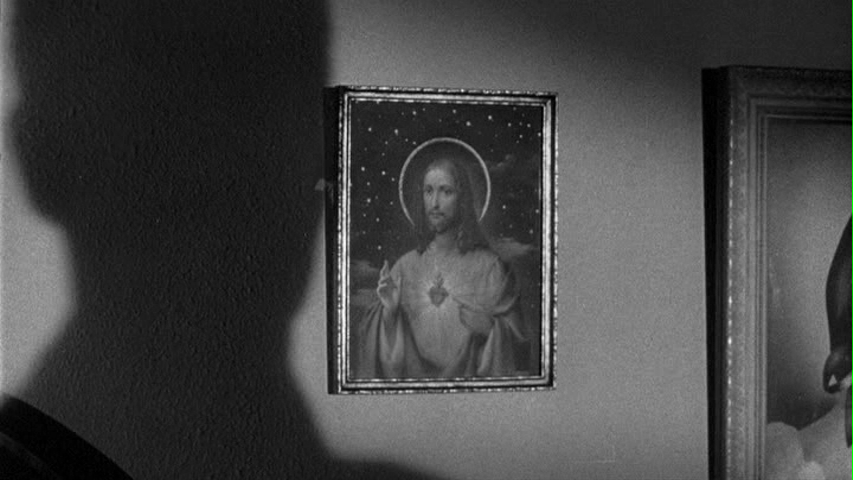
The Wrong Man (1956, Hitchcock, Maxwell Anderson)


I just watched The Wrong Man. Very fine little film. My friend Doug Cummings recommended it to me years ago, in the context of my Soul Food Movies project, and now I see why.

 Even apart from that aspect of the film, it connects with me in a way some other Hitchcock's don't: it seems less cold, more compassionate (or at least empathetic). I like the aesthetic, too: there is the suggestion that it's influenced by the new awareness of foreign film in the mid-fifties - particularly the post-war realism of Rossellini, Satyajit Ray, perhaps Bresson.

 I find it intriguing to notice that all three of those film-makers were very interested in spiritual questions, even as their aesthetic emphasized unvarnished reality.  And fascinating that this sparse, essentially realist film should also be Hitchcock's most explicitly religious - though in a complex way.

Some of that faith element must be credited to the screenwriter (which is so often a glaring oversight in film criticism): playwright Maxwell Anderson, son of a Baptist preacher, whose plays include Journey To Jerusalem, Miracle of the Danube, The Eve of St Mark, Joan of Lorraine (connected with St Joan of Arc), and Lost in the Stars (based on Cry The Beloved Country).

It's easy to over-emphasize (or over-simplify) Hitchcock's Catholicism, as it is Anderson's Baptist background, but there's clearly something going on here.

*

Thinking about the film's connection to the Italian Neo-Realists or Robert Bresson, and their use not only of real locations but also non-professional actors (or "models," Bresson's preferred term), I found these notes from the TCM website:
In a February 1957 American Cinematographer article, Hitchcock was quoted as saying, "I want it to look like it had been photographed in New York in a style unmistakably documentary." According to reviews and contemporary news items, Balestrero's 74th Street home in Jackson Heights, the Stork Club, the 110th and Roosevelt Avenue police stations, Ridgewood Felony Court, and the actual courtroom used for Balestrero's trial at Queens Felony Court were used as location sites in the film. The Greenmont Sanitarium in Ossining, NY and Edelweiss Farm in Cornwall, NY were also real locations from Balestrero's story. In addition, Hitchcock filmed on Queens and Brooklyn streets at cafeterias, delicatessens and liquor stores. The American Cinematographer article reported that O'Connor's office in the Victor Moore Arcade was also used as a shooting site.
According to modern sources, Hitchcock joked that he needed to add to the film all the reality he could get, because the premise of the true story was so unbelievable. Therefore, he used real people from some of the incidents in Balestrero's life in the film. According to the American Cinematographer article, the husband-and-wife liquor store owners, a policeman, detectives and Cornwall resort owners were real people who portrayed themselves in the film. Sherman Billingsley, the well-known proprietor of the Stork Club, also appeared as himself in the film.

Sunday, January 06, 2013

jan 31 + 16 | vertigo

Good choice, Cineplex. The movie that bumped Citizen Kane from top slot on the Sight & Sound once-a-decade poll, just this past summer. Makes me eager to see it again.


Saturday, November 03, 2012

nov 12 | big easy express | mumford & sons

Lots of Soul Food in Mumford & Sons. 
Roll away your stone, I'll roll away mine
Together we can see what we will find...
Cause you told me that I would find a hole
Within the fragile substance of my soul
And I have filled this void with things unreal...
It seems that all my bridges have been burnt
But you say that's exactly how this grace thing works
It's not the long walk home that will change this heart
But the welcome I receive with the restart
Here's a movie they're in.


BIG EASY EXPRESS
VanCity Theatre
Mon Nov 12, 8:50pm
(2012, USA, Emmett Malloy) 67 min

3 bands, 6 cities, 1 train, and thousands of miles of track… the Big Easy Express documents a cinematic musical journey. Directed by renowned filmmaker Emmett Malloy (The White Stripes Under Great White Northern Lights) this new film captures indie folk heroes Edward Sharpe & The Magnetic Zeros, Tennessee’s Old Crow Medicine Show, and Britain’s acclaimed Mumford & Sons, as they embark on a beautiful vintage train in California, setting out for New Orleans, Louisiana on a “tour of dreams”. The resulting film from this journey is nothing short of magical. “An infectiously joyful account of a whistle-stop tour…” Variety “Full of warmth, good music and good vibes that will make you feel like a part of the party while sad that you missed it.” MTV News "Scintilating." Hollywood Reporter

Thursday, November 01, 2012

the wrong man | richard brody


Richard Brody:
"In some ways, the Hitchcock film for people who don’t like Hitchcock films.
The Kafkaesque nightmare of a man who has done nothing wrong, and yet who finds himself caught in a seemingly inextricable web of trouble.
For all of its meticulous practicality, the ultimate subject of the film is metaphysical. Fate, and even God, seem to have conspired against this man. He may be innocent of the crimes of which he is accused, but he's certainly guilty of something, and he becomes aware of it very quickly. Retracing his steps in the attempt to find an alibi forces him to look at his life with an exceptional care, and find all of his flaws exposed.
In the scene where he's taken to the station house and fingerprinted, the ink on his fingers looks to an innocent man like the presence of the mark of Cain."

 excerpted from Richard Brody's New Yorker piece on The Wrong Man (Alfred Hitchcock, 1956)

Saturday, September 29, 2012

viff | soul food options


Lots of nuns and priests and contemptible Evangelicals, but maybe not too much Soul Food among the Religion, Spirituality & Myth selections in this year's VIFF online program guide. I've flagged...

Virgin Tales - "Supplies Evangelical Christians with just enough rope with which to hang themselves..."

Apparition - "About nuns in a cloister convent. We explore this closed world, riven by manias and secrets... Less interested in questions of faith than in the issue of good governance."

Beyond The Hills - "Alina comes apart at the psychological seams, leaving the monastery’s authoritarian priest convinced that she’s possessed..."

Actually, the last of those may go beyond the obligatory Bad Priest angle: "What is remarkable about Beyond the Hills and the unexpected interrogations it awakens is the lingering sense of doubt it leaves you with.  Not merely as to the virtues of organized religion - that would be too simple - but just as much the facile condemnation of it..." (Film Comment)

And while there's not a lot to go on, these two at least catch my curiosity...

Jesus Hospital - "about a woman torn between her comatose mother, her alienated family and her secretive religious beliefs."

Consuming Spirits - "Garrison Keillor-like radio broadcasts in the rundown community of Magguson... While these three central characters may be bound by tragedy, they also possess the capacity to grant one another absolution and release.... A transcendent closing chapter."

So far, though, none of the Soul Food buzz of many previous years - though the Vancouver premiere of Jason Goode's film Late is certainly cause for celebration among Soul Foodies. Other VIFFs have had two or three really exciting SF prospects - Son Of Man and The Mill & The Cross come to mind immediately - but nothing stands out so far in this year's line-up. That said, the most interesting films from a faith perspective often don't show up on the programmers' "Spirituality" list anyhow. A scan of Jewish Interest films may reveal more of interest, for example. But what's really needed is a film-by-film close reading of the full VIFF program. I'll let you know what I find. If you promise to return the favour.

Monday, September 24, 2012

viff | late | jason goode

There's a day this past spring that Jason Goode won't forget. He was at the Cannes Festival showing his latest film when he got word that he'd been nominated for a Jessie Richardson award for his first foray into stage directing, on DANNY & THE DEEP BLUE SEA at Pacific Theatre. The movie was the beautifully filmed, poetic short film LATE, part of Telefilm's "Perspective Canada" program promoting Canadian films at the prestigious international festival. 


LATE
Two strangers struggle for an honest connection in a chance, brief, encounter at a café. Screening as part of Heartbreak, a 75 minute program of short films that take a journey into the infinite — and intricate — depths of the human heart. Ben Cotton, Sarah Deakins, Lucia Frangione, Clint Bargen.

Oct 8 9:30pm | Empire Granville 2
Oct 9 4pm | Pacific Cinematheque

DIRECTOR: Jason Goode
EXEC PRODS Rosie Perera, Jeff Benna, Nick Brampton, Chris Hansen
PROD Dylan Jenkinson
SCR Sarah Deakins
CAM Chris Dalton
ED Greg Ng
Hope of Glory Pictures

Thursday, September 20, 2012

books | the ethical vision of clint eastwood

This just in from IMAGE Update 


Though he may be controversial as a political personality, there is no doubt that Clint Eastwood is a film icon: a winner of five Academy Awards, five Golden Globes, and numerous other accolades for his work as an actor, director, producer, and composer. Yet few critics have ventured to consider Eastwood's philosophical, ethical, and artistic agenda the way film scholar Sara Anson Vaux has in The Ethical Vision of Clint Eastwood.

Bridging popular film and theology, Vaux traces Eastwood's career from Spaghetti Westerns and Dirty Harry-style shoot-em-ups to more recent films such as Million Dollar Baby, Gran Torino, and Invictus. "Seen along a forty-year continuum," Vaux writes, "Eastwood's movies reveal stages in an unfolding moral ontology—a sense of being in the world. They become more sophisticated and nuanced in tone and narrative exploration even if the basic motifs—justice, confession, war and peace, the gathering, and the search for a perfect world—remain the same throughout his career."

Vaux is also quick to refuse the temptation of Christian scholars (or any scholars of a particular camp) to dig through art for validation—for "endorsements of a particular religious system." The film analysis in her book is far from it. In four sections (Westerns, mysteries, war movies, and healing narratives), Vaux peels back the surface of Eastwood's films so the reader can see all the humming parts within: reccurring themes, camera techniques, Hollywood tricks and archetypes, critical reception, the whole shebang—and adds it all up to tell the story of the moral worldview that Eastwood has brought into the living rooms of millions of moviegoers.

This is a book for film critics and movie lovers, Clint Eastwood buffs and academics alike—a film-writing delight.

Wednesday, September 19, 2012

viff | beyond the hills

Could so easily be yet another "Catholic = bad" film. But the Film Comment comment suggests it's maybe more nuanced than that. Here's hoping.

Beyond the Hills
(După dealuri)
(Romania, France, Belgium, 2012, 152 mins, DCP)

Oct 09 10:30 am Granville 2
Oct 11 09:30 pm Granville 7

A nun is torn between her devotion to god and her loyalty to a lifelong companion in Cristian Mungiu’s riveting follow-up to 4 Months, 3 Weeks & 2 Days. "The increments with which the screws of tragedy turn are finely calibrated."--Sight & Sound. Winner, Best Actress (shared by leads Cosmina Stratan and Cristina Flutur), Best Screenplay, Cannes 2012.

After his race-against-the-calendar abortion thriller 4 Months, 3 Weeks & 2 Days, Cristian Mungiu employs a slow-burning brand of suspense in this riveting account of a nun torn between her devotion to god and her loyalty to a lifelong companion. Having found her calling at a remote Romanian monastery, Voichita (Cosmina Stratan) is taken aback by the arrival of Alina (Cristina Flutur), who insists that they flee to Germany together. When the devout nun demurs, Alina comes apart at the psychological seams, leaving the monastery’s authoritarian priest (Valeriu Andriuta) convinced that she’s possessed. As Aline’s rescue attempt cedes to the priest’s relentless efforts to save her soul, Mungiu’s technical brilliance transforms Beyond the Hills into an equally captivating and disconcerting experience. His masterful long takes not only draw us deeper into the women’s trials, they also leave us with no avenue of escape from the mounting tension of his latest provocative tragedy.

"A quintessentially praiseworthy festival film: weighty in intent, unfamiliar enough in setting, rigorously masterful in execution... But what is remarkable about Beyond the Hills and the unexpected interrogations it awakens is the lingering sense of doubt it leaves you with. Not merely as to the virtues of organized religion -- that would be too simple -- but just as much the facile condemnation of it... It is a work that forces you into the not entirely pleasant yet oddly rewarding territory of moral uncertainty."--Joumane Chahine, Film Comment

viff | virgin tales

The "just enough rope to hang themselves" inclines one to think this won't be exactly the "objective and measured examination" of the subject the blurb-writer advertises. But hey...


Virgin Tales
(France, Germany, Switzerland, 2012, 87 mins, HDcam)

Oct 04 06:00 pm Empire Granville 1
Oct 07 12:15 pm Empire Granville 5
Oct 12 03:15 pm Empire Granville 1

What little girl doesn’t grow up dreaming of attending a Purity Ball: a fairy-tale celebration that sees her don an immaculate gown, hang from her father’s arm and vow absolute celibacy until marriage? Created by Randy and Lisa Wilson in 1998, these elaborate (and unnerving) father-daughter formal events are now staged in 48 US states, with one-in-eight American girls taking a purity oath.

Visiting the Wilsons over the course of two years, documentarian Mirjam von Arx reveals them to be devotees of rituals: be it Randy’s verbose blessings, son Logan’s sword-and-scripture "manhood ceremony" or daughter Jordyn’s increasingly despondent video diaries. As her affirmations about "saying no for the greater yes" cede from righteous to rote, Jordyn emerges as a tragic figure. Ultimately, this objective and measured examination of the virtues of abstinence supplies Evangelical Christians with just enough rope with which to hang themselves...

"Von Arx manages to capture moments of pure gold--manufactured "heartfelt" confessions of familial love whose lack of spontaneity is called out by a particularly sassy daughter, or the revelation from the twenty-something daughter (who’s desperately still waiting for her husband to appear) that she didn’t go to college because it would be a "waste of money" since she just wants to be a wife and mother. If it wasn’t so infuriatingly real, the film would make for great comedy."--Basil Tsiokos, Indiewire

viff | apparition

Seems likely not to be Soul Food ("Sandoval is less interested in questions of faith than in the issue of good governance" - ooh, a civics lesson!), but one never knows...

Apparition
(Aparisyon)
(Philippines, 2012, 87 mins, Betacam SP)

Oct 09 05:00 pm Vancity Theatre
Oct 11 06:45 pm Pacific Cinematheque

A startling left-turn after Senorita (VIFF 11), Vincent Sandoval’s new film is about nuns in a cloister convent, like Powell and Pressburger’s Black Narcissus and Jacques Rivette’s La religieuse. It opens with a quote from Gramsci: “The old is dying and the new cannot be born. In this interregnum a great variety of morbid symptoms appears.” We’re in 1971, and the largest morbid symptom around is Ferdinand Marcos’s play for greater political power, which occurs off-screen. But little of the outside world impinges on Adoration, a convent set in secluded woods outside Manila, which sees itself as a physical and spiritual sanctuary. We explore this closed world, riven by manias and secrets, through the eyes of Sister Lourdes, a newly arrived novice. She has hardly settled in before she learns that her activist brother is missing, presumed arrested... She finds ways to venture out to Manila, where a terrible fate awaits her.

Apparition obviously reflects the fact that the Philippines is a predominantly Catholic nation, thanks to its years as a Spanish colony, but Sandoval is less interested in questions of faith than in the issue of good governance. Adoration’s Mother Superior, Ruth, knows much more about what’s going on in the outside world than she lets on. Is she a kind of Marcos, imposing her own kind of martial law?

— Tony Rayns


viff | jesus hospital


Jesus Hospital
(South Korea, 2012, 91 mins, HDCAM)

Oct 03 09:30 pm Granville 1
Oct 05 03:30 pm Pacific Cinematheque

Remember Whang Jungmin, the doting girlfriend in Save the Green Planet? She’s equally great in this heartbreaker, co-directed by woman-and-man team Shin A-go and Lee Sangcheol, about a woman torn between her comatose mother, her alienated family and her secretive religious beliefs. Whang plays Hyunsoon, a milk-delivery woman who masks her own vulnerability behind bull-in-a-china-shop aggression. Her "issues" come to the surface when her brother and sister decide that they can no longer afford hospital bills--and authorize the doctors to withdraw life-support from their mother. Hyunsoon is outraged, and convinced that their mother can yet revive... The film tangles together familial, religious and moral questions in a satisfyingly complex knot. It’s engrossing, very well acted and as punchy as a heavyweight title bout. — Tony Rayns