Saturday, August 18, 2012

viff 2012 | beyond the hills

from Cannes...


BEYOND THE HILLS
(După dealuri)

Romania/France/Belgium | Dir: Cristian Mungiu

A nun is torn between her devotion to god and her loyalty to a lifelong companion in Cristian Mungiu’s riveting follow-up to 4 Months, 3 Weeks & 2 Days. "The increments with which the screws of tragedy turn are finely calibrated."—Sight & Sound.

Winner, Best Actress (shared by leads Cosmina Stratan & Cristina Flutur), Best Screenplay, Cannes 2012.


PS

Sept. 1 - Sneak Preview Guides Hit The Street
Sept. 10 - VIFF Advance Box Office Opens
Sept. 19 - VIFF Official Program Catalogue On Sale
Sept. 26 - VIFF Film + TV Forum Starts
Sept. 27 - VIFF Opens

Friday, August 17, 2012

living pictures passion play


Lancashire workers enjoy the ‘wakes week’ holiday in this early film from travelling filmmakers Mitchell & Kenyon.

This short film was screened up to 20 times a day in August 1901 to entertain the poorer children of Salford. The wakes week was an industrial holiday introduced in the 19th century, involving the annual closure of the workplace to allow for maintenance and leisure time for the workers. This unpaid seven–day holiday for the workers of Lancashire’s textile factories (the women workers are easily recognisable by their shawls) became a social custom. Leisure industries developed due to this increase in recreational time. Travelling fairs would visit during the wakes week to entertain the holidaymakers.

Sight & Sound

Thursday, August 16, 2012

aug 17 + 18 | the mill & the cross | vancity

extraordinary soul food. previous post from viff 2011.


THE MILL AND THE CROSS

vancity  aug 17 8:45 | aug 18 6:45

Poland, 2011, 35mm, 92 min.
Directed by: Lech Majewski
Cast: Rutger Hauer, Charlotte Rampling, Michael York

With creative verve, historical knowledge and aesthetic and political insight Polish artist Lech Majewski brings Pieter Bruegel’s 1564 frieze, The Way to Calvary to life. Bruegel’s canvas transports Christ’s passion to rustic Flanders. It teems with the drama of everyday life. Using computer-generated blue-screen compositing, a massive backdrop painted by Majewski himself, and marshalling dozens of actors, animals and extras, the filmmaker explores this fixed moment inside and out. Among other things, the film is a dazzling tribute to the art of painting and a deft demonstration of the camera’s capacity for time-travel.

“Transfixing… an inspiring, alluring meditation about imagery and storytelling, the common coin of history, religion and art.” —Daniel M Gold, The New York Times

“Here is a film before which words fall silent… If you see no more than the opening shots you will never forget them… A film of great beauty and attention, and watching it is a form of meditation.” **** —Roger Ebert, Chicago Sun-Times

“A feat of artistry worthy of its source. Majewski takes us deep inside the Flemish’s master’s beautiful nightmare… A dazzling master class in visual composition… Coalesces into a surprisingly moving finale. After toil and terror, there can still be joy.” **** —Erik Hynes, Time Out New York

Wednesday, August 01, 2012

sight & sound | 2012 poll results

The top fifty, selected by 846 critics, academics, programmers and distributors. All the details on the once-a-decade poll can be found at the Sight & Sound website.

The big news: Citizen Kane drops from the Number One position for the first time since the inaugural 1952 poll, where the Orson Welles film wasn't among the top ten. Not a good day for Welles, with Touch Of Evil (formerly #15), The Magnificent Ambersons and The Third Man (formerly tied at #35) dropping right off the charts.

The last ten years have also been cruel to Ingmar Bergman. While Persona joins the party at #17, Wild Strawberries (#27 in 2002), and Fanny and Alexander and The Seventh Seal (previously tied at #35) have been frozen out completely. ("Fanny and Alexander and The Seventh Seal" - sounds like an adventure story for kids).


And these are the films that disappeared.


For the time being, only the top ten films of the Directors' poll are available. Again, Kane falls. The Godfather holds on better than in the Critics' poll. In general, the American auteurs of the seventies do well with this crowd: though Raging Bull dropped from the top ten, Taxi Driver and Apocalypse Now were added.


More to come;
Aug 3/4: August issue of Sight & Sound released in UK: complete list of 100 films
Aug 7: August issue available as digital download (Apple Newsstand)
Aug 15: complete critics’ poll of 846 entries in interactive form on S&S website
Aug 22: complete interactive directors’ poll online (358 entries) added

sight & sound | 2002 poll results

In about 15 minutes, Sight & Sound magazine will begin announcing the results of their once-a-decade poll of critics and directors - certainly the most significant of the cinephile lists (as opposed to more populist tallies such as IMDb).

 Advance word is that Citizen Kane has been dislodged from the top slot on one of the two lists - first time since the inaugural poll in 1952, where Kane didn't make the Top Ten.

Also worth keeping an eye on are the Godfather films: while "The Godfather and The Godfather II" placed high on both critics' and directors' polls, landing at the number three spot overall, it's hard to know how those votes were tallied. Some critics voted for the two films as a unit, others voted separately for the two films, and some voted for "The Godfather Trilogy." In 2012, the rules have been clarified: separate voting for each. Another factor is that the field of "voters" was expanded significantly this year, with 1000 critics invited to submit their lists, including many online critics not previously polled. Which bodes well for The Godfather. (And Star Wars...)

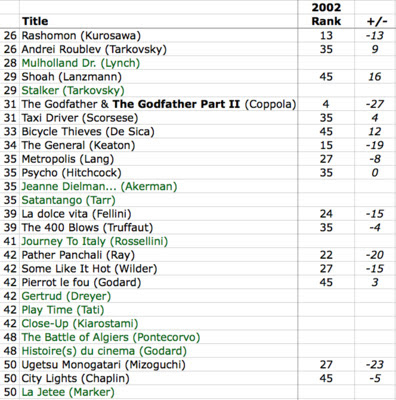
 Here's a rundown of how the films fared in the last poll (2002). I've combined the votes from critics and directors to see how the list would look without that distinction: the red and blue columns provide the placements on the two separate polls.


Saturday, July 28, 2012

higher ground | carolyn s. briggs

Higher Ground is a 2011 film that examines a woman's experiences in a slightly-post-Jesus-People church community through the seventies and into the eighties. Extremely accurately, and I feel sympathetically, observed - enough so that if you've fled that world, it will push a lot of buttons, and if you're still in that world, it will push a lot of buttons, and if you've never gone near that world, these folks will just look like loonies. I don't think any of those responses is really intended: like the book it comes from, it's a memoir, and simply aims to portray a series of experiences. Maybe I was the perfect audience member:  I only ever visited that world, and have never really stopped visiting, so it didn't rile me up - I mostly marvelled at how much they got right, and how little they condescended.  The Carolyn S. Briggs memoir was originally titled "This Dark World," which was changed to tie in with the release of the film - which is currently showing on Canadian Netflix. 


Do you have any regrets in writing This Dark World?

Sure. I wish I would have allowed for more time to pass, so that my perspective cleared a bit. I regret the book was edited in such a way that I appear to have wholly rejected my faith—which I have not ever been able to do. In writing memoir, one tells one’s story, obviously, but one also tells other people’s stories who may not want their stories told—especially from someone else’s perspective. I have wrestled with this reality and continue to as the film is released.

Where are you with your faith right now?

I could not live in a world without God. And this God is big enough to contain my doubts. Tobias Wolff says doubt is part of faith. Doubt and faith can co-exist; each informs the other. My faith infuses my doubt and my doubt infuses my faith. What else can I do but keep seeking God? Tolstoy advised a life of seeking God because that assures a life with God.

Do you consider yourself a Christian?

I understand that Christian hipsters are using the hyphenated word Christ-follower these days. I’m too old and not cool enough to be a hipster, but I love that idea. I am striving, pressing on, working out my salvation in fear and trembling. I can’t think of anyone or anything better to follow than Jesus Christ.

I titled the screenplay Higher Ground because I wanted to show Corrine as a character reaching for God, reaching for higher ground throughout her life. As Vera says in interviews, Corrine is not leaving her faith. She is leaving an impoverished faith.

from Carolyn S. Briggs' website

Friday, July 27, 2012

watching for... into the abyss

July 2012: currently showing on Canadian Netflix


Nine years after the murder of three people in Montgomery, Texas, in 2001, Werner Herzog patiently but persistently interviewed the convicted killers, as well as the victims' relatives, the chaplain who presides at the prison's executions, and a former executioner who has lost his taste for the work. As in Truman Capote's "In Cold Blood," the crime itself is unimaginably stupid (two nineteen-year-old boys set out to steal a car and wound up committing the murders), and Herzog's attention moves to the pathology that produced them and the devastation left in the wake of the crime. It is yet another of Herzog's leaps into moral chaos, but there are elements of love and self-knowledge in the families of both victims and perpetrators that are extremely moving. You come out shaken by the fathomless destructiveness of idiocy and the healing powers of belief and remediation. The New Yorker, David Denby

Saturday, July 21, 2012

notes on margaret


The DVD is out, including two cuts. The one that was in theatres, of which the director approved, and a second cut by the director himself. Since the editing of the film was a big brouhaha, it adds interest to see what Lonergan himself would have done - or, in fact, has done - with the film.

It's well known that there's been endless offscreen drama with this one, leading up to production and particularly afterward. There's validity on both sides of the controversy: the studios may well have looked at a film that doesn't have a story-driven structure and wanted an edit that would pull the narrative to the fore - and who can blame them, they stood to lose millions - while the director stuck to his vision, of a different sort of film altogether. More like a novel (that's not written by Stephen King or John Grisham), with a story that meanders, takes time to simply investigate a life, spends time on scenes and events that don't add to the flow or build momentum, but are simply experiences the character has.

Ursula LeGuin proposed what she called the "carrier bag" approach to fiction, as opposed to more linear, story-driven narrative. More observational, less cause-and-effect. It's very common, as I mentioned, in literary novels. And that's how Margaret feels to me.

Lonergan is perfectly capable of the well-structured story. You Can Count On Me is terrific that way, while also being non-Hollywood, non-King/Gresham. It's just that Margaret is different.

*

Lots of fun actors: Mark Ruffalo (whose break was You Can Count On Me), Stephen Adly Giurgis (who wrote Jesus Hopped The A Train and The Last Days Of Judas Iscariot), Jean Reno, Matt Damon, Matthew Broderick (Ferris Bueller, no longer skipping class - as in Election), and of course Anna Paquin.

The Lear scene reminded me so much of Frederick Buechner's great high school English class scene in Open Heart (97-101). An important scene for Buechner: he includes the whole section in Telling The Truth: The Gospel as Tragedy, Comedy and Fairy Tale (26-30). Far and away, two of Buechner's finest books.

I wonder how many films have names for titles - which aren't the name of a character in the film. Particularly effective here, and another of the touches that makes the film at least hover around the edges of Christian faith. As does You Can Count On Me.

Tuesday, July 17, 2012

the amazing spider-man | anthony lane


The first “Spider-Man” came out in 2002, followed by its obligatory sequels in 2004 and 2007. If you are a twenty-year-old male of unvarnished social aptitude, those movies will seem like much-loved classics that have eaten up half your lifetime. They beg to be interpreted anew, just as Shakespeare’s history plays should be freshly staged by every generation. For those of us who are lavishly cobwebbed with time, however, the notion of yet another Spider-Man saga, this soon, does seem hasty, and I wish that the good people – or, at any rate, the patent lawyers – at Marvel Comics could at least have taken the opportunity to elide the intensely annoying hypen in the title.

Peter Parker is played by Andrew Garfield, who was excellent as the hapless Eduardo Saverin in The Social Network, and he still bears the mournful traces of a smart kid who had to agree to an out-of-court settlement. If anything, he is rather too mournful. I know that years of sappy cinema have left me lachrymose-intolerant, but I really couldn’t understand why Garfield’s Bambi eyes kept glingint with a mist of tears. His closest friend is a skateboard, which I guess is a step up from Mark Zuckerberg.

The new batch of ten-year-olds, receiving their first hit of arachnomania – what will they have learned from this instructive film? One thing: if you want to grab a girl, as Peter does, you eject a strand of sticky stuff onto her from behind, then pull. Not true, kids. Don’t try it at home.

by Anthony Lane
excerpted from The New Yorker, July 9 & 16, 2012

Monday, July 16, 2012

jason goode + dylan jenkinson | cannes

DANNY AND THE DEEP BLUE SEA was the first full-length play Jason Goode had directed. So how's this - he received word of his Jessie Richardson Award nomination as outstanding director for that show while he was at the Cannes Festival in support of his latest short film! Not many days in a person's life are going to beat that.


Jason and his creative partner Dylan Jenkinson were profiled in Light Magazine: here are excerpts, with the full article at the web site.

Still from the film shoot of LATE
with Sarah Deakins and Ben Cotton

Christian Filmmakers showcase their talent
by Christina Crook

Dylan Jenkinson and Jason Goode’s short film Late was their ticket to the world’s most illustrious film festival – the Cannes International Film Festival. The two Christians from Vancouver made good on their supporters’ dollars and pounded the pavement, drumming up interest for their short film.

Each year the festival previews new films of all genres from around the world. Founded in 1946, it is the world’s most prestigious and publicized film festival and is an invitation-only event. So, when Telefilm Canada called to tell Jenkinson and Goode that their film was chosen for Telefilm’s ‘Canada’s Not Short on Talent’ showcase at Cannes, they leapt at the opportunity.

Late, written by Sarah Deakins, tells the story of two strangers who struggle for a completely honest connection in a brief, chance encounter at a café. Goode’s directing paired with Jenkinsons’ producing, created a stunning black and white film that showed to a sold-out crowd in France....

Jenkinson and Goode’s collaboration began three and a half years ago. “I remember talking to Jason about creating work that means something and I didn’t feel like I could do that by myself; I didn’t want to do it on my own,” confesses Jenkinson. The two traveled to a friend’s cottage on Galiano Island where they spent a day and night hearing each other’s stories. Goode had tried collaborations in the past but they didn’t seem to work, but in the case of Jenkinson, foremost a visually-driven producer, while Goode is more performance focused, they complemented one another well....

Jenkinson’s career in motion pictures began in 1998 with eight eclectic years in the physical production arena before transitioning into story development at Keystone Entertainment where he was the Development Executive for two very successful Disney DVD titles. In 2008 he attended the Producers’ Lab at the prestigious Canadian Film Centre.

Goode, whose directorial work includes the short films The Hitchhiker and the Leo-nominated The Planting, also recently directed John Patrick Shanley’s Danny and the Deep Blue Sea at Pacific Theatre in Vancouver. He holds a Masters degree from Regent College and is a dedicated stay-at-home father by day....

In the case of their feature film Numb, Goode came upon the script by award-winning screenwriter Andre Harden, a former artist-in-residence at L’Abri Canada, and resonated at once with it.

Numb tells the story of a debt-ridden couple who discover a map promising to lead them to a fortune of stolen gold. They partner with a pair of mysterious hitchhikers to enter the remote winter wilderness and recover the coins. What they soon discover is that the only thing more blinding than snow is greed.

“I love the quote from East of Eden that says: “There’s more beauty in the truth even if it is dreadful beauty. The storytellers at the city gate twist life so it looks sweet to the lazy and the stupid and the weak, and this only strengthens their infirmities and teaches nothing, cures nothing, nor does it let the heart soar,” says Goode.

Saturday, July 07, 2012

precious


photo credit: Last Exit To Nowhere

transcendent darkness | scott derrickson | glen workshop jul 29 - aug 5

I've heard Scott talk about film - Taxi Driver, in fact - and that makes me think this would be terrific. Insightful, enthusiastic. He really loves movies - and he actually makes movies. 
Too, everybody I know who's gone to the Glen Workshops say it's a tremendous experience. (I'm talking myself into it!) What's great is that even for those of us who can't go, Mr D has provided a swell movie list, of films that may be included in the week. That REALLY is a good list...


Transcendent Darkness
Taxi Driver (1976, USA, Martin Scorsese)
Apocalypse Now (1979, USA, Francis Ford Coppola)
Blade Runner (1982, USA, Ridley Scott)
The Exorcist (1973, USA, William Friedkin)
The Shining (1980, UK/USA, Stanley Kubrick)
Breaking the Waves (1996, Denmark, Lars von Trier)
Seven (1995, USA, David Fincher)
Out of The Past (1947, USA, Jacques Tourneur)
Night of the Hunter (1955, USA, Charles Laughton)
Rashomon (1950, Japan, Akira Kurosawa)
Cries and Whispers (1972, Sweden, Ingmar Bergman)
Repulsion (1965, USA, Roman Polanski)
Films that have provided the most transcendent experiences
for Scott Derrickson as a Christian and as a filmmaker


Scott Derrickson, the director of The Exorcism of Emily Rose and the upcoming Sinister, is a connoisseur of the darker traditions of cinema and uniquely situated to speak to the significance of Christian relevance within them. His own spiritual journey—from fundamentalism through evangelicalism and beyond—has been accompanied by an artistic journey that he will share with the class. This seminar and its accompanying discussion will be unafraid to confront the grotesque in the context of grace, in the grand tradition of Flannery O’Connor. In the end, Derrickson believes, confronting the darkness in us is often not only a prelude to understanding grace, hope, and redemption, but can itself be an experience of the divine. The selection of films, from horror to film noir and more, will be a guided tour through the films that have provided the most transcendent experiences for Derrickson as a Christian and as a filmmaker.

Derrickson graduated from Biola University with a B.A. in Humanities with an emphasis in literature and philosophy, a B.A. in Communications with an emphasis in film, and a minor in theological studies. He earned his M.A. in film production from USC School of Cinematic Arts. Derrickson co-wrote and directed the film The Exorcism of Emily Rose, which was loosely based on a true story about Anneliese Michel, and won a Saturn Award for Best Horror Film and a place on the Chicago Film Critics Association list of the Top 100 Scariest Films Ever Made. Derrickson also directed The Day the Earth Stood Still starring Keanu Reeves and Jennifer Connelly, written by David Scarpa. Derrickson is currently attached to write and/or direct several films, including an adaptation of Dan Simmons' Hyperion and The Fall of Hyperion, a remake of the Danish thriller The Substitute (produced by Sam Raimi), a supernatural suspense thriller called The Living, and an action movie about the biblical Goliath. Derrickson recently agreed to team with producer Jason Blum (Paranormal Activity, Insidious) to direct Sinister, a mystery-horror crime film starring Ethan Hawke. He is also currently working on Two Eyes Staring, a horror film starring Charlize Theron, and writing the TV pilot Thunderstruck for AMC, which is based on the Hugo and Nebula award winning short story Hell is the Absence of God.

Taxi Driver art print by Joe Taylor

Friday, June 15, 2012

New Yorker | career

"And they said my career was over after 'The Godfather.'"

Brad Stratton, Franklin, Wis.
The New Yorker, June 4 & 11, 2011

Friday, June 08, 2012

moonrise kingdom

Nothing particularly Soul Foodish about this one. But I'm in love.
After the screening, I asked Carole if she liked it. "Yes. But not as much as you did. Nobody in the theatre liked it as much as you did." My favourite Wes Anderson yet. The second of my true favourite films in 2013.


sight & sound & tree of life

Note from my movie pal Peter

Not sure whether you're that into the deca-annual Sight & Sound poll. (I certainly get excited about it, especially the 2002 version with its online database.)

For what it's worth on the soul food front, though, I've read two voters for this year's poll (results forthcoming in August, I believe) who have divulged their lists: Roger Ebert and Peter Howell. They both voted for Tree of Life.

It's exceedingly unusual for a newish movie to crack the heights of the consensus, (it's a regular beef people have with the survey that nothing new seems to score high these days), let alone a movie released the year before. And it's very unlikely that Tree of Life is going to do so. But, based on the two lists I've seen, it's already two-for-two! Interesting.

Tuesday, May 22, 2012

anthony lane on the avengers


The first scene is set in an undesignated patch of outer space, where some masked moaner yaks on in a rich and threatening baritone. I couldn't understand a word until he asked, 'The humans - what can they do but burn?' If he is referring to our cooking skills, this is grossly unfair, for we can also poach, broil, gently simmer, and steam en papillote. . . .

Loki (Tom Hiddleston) is a tall, well-spoken megalomaniac who bears a magic spear, although, for anyone who enjoyed Hiddleston's spry and convincing turn in Midnight In Paris, the world would appear to be at the mercy of F. Scott Fitzgerald with a monkey wrench.

One of the failings of Marvel - as of other franchises, like the Superman series - is the vulgarity that comes of thinking big. As a rule, be wary of any guy who dwells upon the fate of mankind, unless he can prove that he was born in Bethlehem. . . . I remember the joy of reading Dvid Thomson's entry on Howard Hawks, in A Biographical Dictionary of Film; the principle underlying Hawks's work, Thomson argued, was that 'Men are more expressive rolling a cigarette than saving the world.' All movies thrive on the rustle of private detail - on pleasures and pains that last as long as a smoke - and there has been nothing more peculiar, in recent years, than watching one Marvel epic after the next, then sifting through the rubble of gigantism in search of dramatic life. . . .

Come the climax, Thor tosses his mallet, Iron Man hurls energy pulses from his palms, while Captain America waves his slightly underwhelming shield, and, not to be left out, Black Widow repels invading aliens through the sheer force of her corsetry. . . .

The New Yorker, May 14, 2012

Sunday, May 20, 2012

damsels in distress

Big Whit Stillman fan. So how is it that I completely missed DAMSELS IN DISTRESS when it played Vancouver, after so long a wait since THE LAST DAYS OF DISCO? And not a video store or second run movie house in sight. Alas. It's a fallen world.

"It may be that, as a follower of Whit Stillman, you would like your man to branch out a little, and to direct a 3-D spectacular about ectoplasmic aliens waging nuclear vendettas against the U.S. Marine Corps on the naked streets of Detroit. If so, you must wait a little longer. His new film, like its predecessors, contents itself with a closed and rarefied world - in this case, the campus of Seven Oaks college, home to a bunch of floral friends. There is Violet, heather, Rose, and Lily, and they look down with fond despair on the rest of mankind, especially the male of the species. Not much happens: lovers are acquired and dropped, aromatic soaps are sniffed, and students give voice to complete sentences of a kind scarcely heard in modern cinema. Stillman has not lost the power to bewitch; in the confident reach of his artifice, in the unembarrassed hues of his decor, and in his willingness to enroll his dweebish characters in old-style song and dance, he has delivered his most ludic and peculiar project to date." The New Yorker

ludic | playful in an aimless way: the ludic behavior of kittens 
(I didn't know either)

Friday, May 18, 2012

july 10 | margaret on dvd

In a year when I've seen so few movies, it may be no great distinction that MARGARET is far and away my favourite. But I suspect that in any movie-going year, it would still have that distinction. In spite of, and more often because of, its idiosyncratic McKee-defying structure, I was smitten with this film. I was taking a fiction course with Loren Wilkinson, and thinking about how a novel feels and works, with its "carrier bag" full of observations, diversions, side events and irrelevancies, compared to the concision and plot-centredness of plays and movies. And it struck me that MARGARET allowed itself to wander, to include things that had no real plot function, but which served to build out the world of the character, to make a wider sense of the life she was living in, with all the quotidian detail and non-consequential events that fill any real life. There was a loose-limbed quality to the film I found beguiling and enveloping. I lost myself in its expansiveness, I moved in the way you move into a new home or a neighbourhood, the way you can sometimes move into a novel.

So I rejoice find MARGARET coming to a DVD player near me. And, like Brody, I rejoice that there's an even bigger world to settle into this time around.

MORE OF MARGARET TO LOVE
Richard Brody, The Front Row
(film blog of The New Yorker), May 15 2012

It’s great news that Kenneth Lonergan’s “Margaret” will be coming to DVD (and Blu-ray) on July 10th (at first available solely from Amazon), and that, in addition to the two-and-a-half-hour version of the film that was released theatrically last fall, the set will feature a three-hour-and-six-minute extended cut by the director, which will give us more of “Margaret” to love. I devoured the released version like cake, despite having the sense that some subplots that crop up toward the end of the film went by rather fast, offering less of a look at the protagonist Lisa Cohen (Anna Paquin) in her intimate moments and fewer of the lyrical urban-landscape grace notes that adorn the rest of the film.

Unless one has just returned from a year in Antarctica, it’s impossible to have avoided reports about the long script that Lonergan wrote, the long cut that existed at some point, the conflicts that arose in the course of editing, and the delayed and diffident release. None of this matters to understanding the great and distinctive beauty of the film, or to its ascension to its legitimate place in the history of cinema (though of course it matters practically and, doubtless, emotionally, to Lonergan and his cast and crew, whose just recognition for making this masterwork has come unduly late), but it sets the imagination ranging in aesthetic lust for what else might be there.

I wanted “Margaret” to last longer; I simply wanted more. Yet strange things do happen when alternate versions of a movie appears. I saw Sergio Leone’s “Once Upon a Time in America” the weekend it was released, in 1984—in a two-and-a-quarter-hour version, which proceeded chronologically, starting with its characters’ childhood, and which, as a result, offered one of the great coups de cinema of my experience: the decades-long leap that reveals the character called Noodles as an old man. Little did I know that Leone had shown it at the Cannes Film Festival several weeks earlier in a nearly four-hour cut that featured an intricate flashback structure. And when, several years later, I finally got to see, at MOMA, that longer version, I was thrilled by its fullness and yet dismayed that the flashbacks eliminated the late-in-the-movie leap. (Leone’s original version was even longer—two hundred and sixty-nine minutes—and this version will be premièred at this year’s Cannes festival, which opens tomorrow.)

Every version has its delights and its significance. The haste that marks the latter part of “Margaret” also conveys a sense of implacability, a feeling of experience accelerating under pressure. (And, though I’d be surprised if there should turn out to be a drastic difference in structure between the released version and the extended one, surprises are exactly what to expect from artists of Lonergan’s calibre. I interviewed him about the film earlier this year; his remarks are full of fascinating surprises.) There’s nothing to match the exhilaration of a first discovery and the affection that attaches to a film as first seen (though the story behind the released version of Jean Vigo’s “L’Atalante“—which, for its original release, was altered even unto its very title—is cautionary), yet I fully expect to revel in the longer cut of the film and to view, repeatedly, new material with gratitude and with love. Not only is “Margaret” finally coming to DVD, but thirty-six more minutes of it are en route; it’s a joy to anticipate and to announce.

Wednesday, May 16, 2012

we have a pope

If a thing's worth doing, it's worth doing twice.  Check out Saving Grace - not the dope-growing Saving Grace from 2000, and not the angel-redeems-jaded-cop Saving Grace TV series (2000-2010), but rather the Pope-on-the-lam Tom Conti vehicle from 1985.


We Have a Pope
(2012, Italy, Nanni Moretti)

"A new man is elected to the throne of St. Peter, but Cardinal Melville (Michel Piccoli) was hardly the expected choice, nor, it appears, does he want the job. On the contrary, he is in anguish, refusing to greet the faithful from the balcony, and thrown into a befuddled semi-silence. A psychoanalyst — played by the movie’s director, Nanni Moretti — is brought in to help the stricken Pope, although the film fights shy of that promising setup. Instead, the patient escapes, wandering Rome unrecognized, and falls in with a troupe of actors who are presenting a production of Chekhov—the implication being that performance itself can have a therapeutic effect. (On the other hand, it is precisely the prospect of a constant public role that oppresses the Holy Father.) Meanwhile, the shrink remains in the Vatican, coaching the Cardinals to play basketball; it’s too slight and charming a conceit to carry much force in the story, and some Moretti fans will be taken aback by the mildness of the whole enterprise. Yet the drama is framed with great elegance, and, in the pathos of Piccoli—an old man as harried as a child—we feel how weighty and stifling the robes of state must be. In Italian." Anthony Lane, The New Yorker

Richard Brody, also writing for The New Yorker, doesn't see the film as "mild" at all...

"The lag time in the distribution of foreign (and, for that matter, American independent) films is a matter of concern — as with Nanni Moretti’s We Have a Pope, which was shown at the Cannes Film Festival last May, and is finally opening today [Apr 6] in New York and Los Angeles (and will be available next Wednesday [Apr 12] on nationwide video-on-demand). ... Melville escapes from the enclave and wanders through Rome. What he discovers is nothing special — a world full of ordinary people doing ordinary but noteworthy things. Beneath its silken cloak, Moretti’s film is a wildly anarchic, furiously radical criticism of the Catholic Church. There’s no criticism of any particular church doctrine or mandate; rather, Moretti takes on the church as an institution, suggesting that it’s grotesquely hypocritical, even a betrayal of Christian faith, to run a church without being in the habit walking in the street and getting dog shit on your shoes. He challenges the notion of a church that is run from a palace and that functions like a regressive corporation that, with its arcane and rigid laws, does everything possible to keep its highest officials insulated from the world to which they presume to minister." Richard Brody, The New Yorker

Wednesday, May 09, 2012