Friday, August 19, 2011

Anne Lamott on LATCHO DROM


LATCHO DROM (SAFE PASSAGE, 1993, France)
"But oh, the old women dancing: the old women who shine with the incredible stirring of spirit that has kept them lit over the years, even though the winds howl all around them."

Anne Lamott says her two best prayers are "Help me, help me, help me" and "Thank you, thank you, thank you." Sometimes one leads to the other.

One time in particular, the answer to the first and the route to the second was a movie. In love with a man and suddenly, desperately self-conscious, she found herself loathing the face and body that are the legacy of four hard-lived decades on this planet. "Even though both feminism and Christianity have taught me that I am my spirit, my heart, all that I have survived over the years and all that I have given, still a funny thing happened after I started liking this guy: I looked in the mirror, and sighed, and thought to myself, I will cut my eyes out."

The still, small voice prevailed – "this little-kid voice, this Tweety-bird voice" – and she asked God for "a little help with this stupidity." And what do you know, iInside ten minutes, friends called and she was on her way to see Latcho Drom, a film about gypsies, without dialogue, filled with dancing and singing and... Faces.
"The gypsies are all born old. The men are dashingly homely, as if cars have ridden over their faces. The young girls are beautiful beyond words, and the oldest women dance. But the middle-aged mothers look just like me and my friends – tired, baggy, in need of some repair."

She doesn't want to see this movie, but it begins to draw her in, to lift her up out of whatever it was she had been sinking down into. And as the old women dance, and she feels "the rush of the life force" inside them, inside her, she begins to se them – and possible, potentially, herself? – as the younger gypsies see them: "absolutely beautiful, visibly beautiful, like movie stars."

"Gypsies" is a piece of movie writing you really must read. Just as the book it comes from, Traveling Mercies, is a work of spiritual biography you really must spend some time with. Lamott is a gifted story-teller, an acute observer, a dazzling and hilarious stylist: coming to faith later in life after an intentionally non-Christian, countercultural upbringing (not that authentic Christianity isn't countercultural, but you know what I mean) and a prodigal young adulthood, the fresh wildness of her faith is breath-taking. Just as Aslan is not a tame lion, Anne is certainly not a tame Christian.

It's no surprise to me that God would use a sensual, soulful film like Latcho Drom to speak grace into the heart of this woman: a film that's not religious in any conventional sense, that's about bodies and faces, about soul and the spirit of a people, without being in any way about spiritual things. Jesus can make wine from any water – it's astounding to see what He can concoct from such a heady brew as this!

"Coming out of the movie that night, I realized that I want what the crones have: time for all those long deep breaths, time to watch more closely, time to learn to enjoy what I've always been afraid of – the sag and the invisibility, the ease of understanding that life is not about doing. The crones understand this, and it gives them all kinds of time – time to get much less done, time for all these holy moments."

Thursday, August 18, 2011

Secret Sunshine on Criterion


New Criterion release. I saw this at the VIFF a few years ago, a Korean story about a woman in desperate straits who becomes involved with evangelical / charismatic Christians. I found it a pretty grim film, and it seemed to me that the Christians, while portrayed honestly and accurately enough, were weighed in the balance and found wanting. But you can decide for yourself. It's definitely a strong film.

Here's what Criterion has to say:
For this exquisite drama about faith and the search for redemption in the face of tragedy, Jeon Do-yeon was awarded the best actress prize at the Cannes Film Festival. It’s easy to see why: her devastating portrayal of the widowed piano teacher Shin-ae, trying to start her life over with her young son in a new town, is a master class in subtle expressivity. Secret Sunshine is a raw, unpredictable journey, led by a filmmaker you’ll be hearing a lot more about in coming years.
And, elsewhere,
A master of intensely emotional human dramas, director Lee Chang-dong is a luminary of contemporary Korean cinema, and his place on the international stage was cemented by this stirring and unpredictable work examining grief and deliverance. An effortless mix of lightness and uncompromising darkness, Secret Sunshine (Miryang) stars Cannes best actress winner Jeon Do-yeon as a widowed piano teacher who moves with her young son from Seoul to her late husband’s provincial hometown for a fresh start. Quietly expressive, supple filmmaking and sublime, subtle performances distinguish this remarkable portrayal of the search for grace amid tragedy.

Wednesday, August 10, 2011

aug 17 & 28 | m*a*s*h | cineplex classic films


M*A*S*H (1970)
"M*A*S*H Gives a D*A*M*N"
Directed by: Robert Altman
Cast: Donald Sutherland, Elliot Gould, Tom Skerritt, Robert Duvall, Sally Kellerman, Rene Auberjonois
Plot: The staff of a Korean War field hospital use humor and hijinks to keep their sanity in the face of the horror of war.

Wednesday, August 17, 7:00pm
Sunday, August 28, 1:00pm

Presented in HD. All tickets five dollars. SilverCity Riverport, SilverCity Coquitlam, Colossus Langley, Scotiabank Theatre. The Classic Film Series presents one great title each month on the big screen from September 2010 to August 2011: details here.

M*A*S*H is available on DVD and Blu-ray at Videomatica

Saturday, July 30, 2011

watching for... SUING THE DEVIL


Trailer looks a little shoddy, but intriguing premise. In theatres Aug 26.

Double feature with "The Man Who Sued God"?

Wednesday, July 27, 2011

mubi | my father my lord

Soul Food Movie pal Rosie Perera recommends this recent find: "beautiful, powerful, challenging, worth discussing. Definitely soul food." (She also says to ignore the note there that says there are no English subtitles: it's got subtitles, not to worry).

It's on the MUBI website, streamable for three bucks.


MY FATHER MY LORD
(2007, Israel, Hofshat Kaits)

Abraham Eidelmann, an old ultra-orthodox rabbi, has a young wife, Esther, and a young son, Menahem. He spends all his time praying, studying the Torah and preparing his sermons. Abraham has not much time to devote to Esther, who craves affection, nor to Menahem, who is awakening to life. But today Menahem is happy. His father has accepted to go to the Dead Sea for their holidays.

Winner of the Best Cinematography and Best Director awards at the 2006 Haifa International Film Festival, and the Best Narrative Feature at the 2007 Tribeca Film Fest in New York.

Friday, July 22, 2011

the new world | lumia


Terrence Malick's ... cosmically tinged movie, about a family in Waco, Texas, in the nineteen-fifties, and the creation of the world, among other things, begins and ends with a shifting flame of red-yellow light. Critics have been confounded by the flame. Robert Koehler, of Variety, dismissed it as a “yolk-colored blob”; Amy Taubin, writing in ArtForum, called it “a great whatsit”; and Anthony Lane described it in these pages as “glimmers of unfathomable light.” The Times' A.O. Scott concluded that it “can only represent the creator.”

So what, exactly, is the “great whatsit”? Malick isn't telling - he hasn't granted an interview about his work since the nineteen-seventies. The Tree Of Life's credits, however, reveal the image to be the light artist Thomas Wilfred's “Opus 161” (1965-66). Now largely forgotten, Wilfred's “lumia compositions,” as he called them, are both feats of bric-a-brac engineering and ethereal works of art. He employed reflective mirrors, hand-painted glass disks, and bent pieces of metal - all housed in a screened wooden cabinet, or, in one case, mounted on a walnut “tea wagon” - to transform beams of light produced by a series of lamps and lenses. To look inside a lumia instrument is to see an apparent scrap heap put to near-magical use. Wilfred began honing his technique in the nineteen-twenties, and by the forties and fifties his work was in the Metropolitan Museum of Art, the Whitney, and the Museum of Modern Art. MOMA's founding director, Alfred H. Barr, Jr., wrote to Wilfred, in 1959, “I think it would please you to know that we receive more letters and telephone calls asking for information aout Lumia than about any other single work in the Museum's collection.”

A piecemeal transcendentalist, Wilfred sought to represent “the universal rhythmic flow” in his art. He produced roughly forty works before his death, in 1968. Only eighteen lumia pieces have survived. (Clare Boothe Luce's is in storage at the Honolulu Academy of Arts.) One of these is “Luccata, Opus 162,” whic is currently on display at the Los Angeles County Museum of Art. The piece is on loan from the collection of Eugene Epstein, a retired radio astronomer, and his wife, Carol, who own about half of the extant Wilfreds, including the one featured in The Tree Of Life. “These are rarely seen,” Epstein explained the other day. “I you haven't seen one in person, you're totally unaware of them.” This is largely owing to the fact that Wilfred resisted attempts to record the lumia. “I have never permitted any of my works to be filmed,” he wrote in 1962. “We have experimented with the process here and the results have been too poor to be considered.”

Malick's crew first contacted Epstein four years ago about filming “Opus 161,” which they recorded both at LACMA and at the Epstein's home in Los Angeles. The piece runs without repeating itself for one year, three hundred and fifteen days, and twelve hours, although it occupies only about a minute or two of screen time in The Tree of Life. Epstein recalled speaking to one of Malick's producers: “They were trying to capture something about creation and so on, and they were wondering if they could used lumia.” Epstein, who consideres the preservation of Wilfred's works and legacy to be his “life's mission,” is not a film buff, and he did not immediately recognize Malick's name. “Terrence and his wife came over for an afternoon, “he said. “I was told he was a prominent director. He's a bright guy, very cordial, nothing pretentious or anything about him. He didn't come swooping in with an entourage.”


Epstein discovered Wilfred's work in 1960, while visiting MOMA as a graduate student. “There was this darkened alcove where 'Opus 137' was,” he recalled. “It just hit me like a ton of bricks. I stood there for a while watchig, and then my feet got tired, and then I just sat down on the floor and watched some more.” When asked what strikes him about lumia, he says, “Sublime, ineluctable beauty. It's a visceral joy.”

Joshua White, the founder of the nineteen-sixties psychedelic multimedia outfit the Joshua Light Show, also cites Wilfred as one of his primary influences. He recalled taking girlfriends to MOMA after school to stare at the Wilfreds. “He was making something that I call 'fugitive art,’” said White, who was taking a break from prepping a recent three-night stint at the Hayden Planetarium. “You couldn't take a picture of someone looking at a Wilfred, really, because it was so fragile, and the recording medium didn't exist.”

White, who found lumia to have pacific qualities - “I was kind of a hyper child,” he said; “the Wilfred calmed me down” - links his work to his predecessor's: “Light, especially when it's been abstracted by a genius like Thomas Wilfred, the whole point is it's a little ambiguous. You see what you want to see. We make something for you to interpret in your head, so that everybody sees a different light show.” The same, it seems, can be said of film critics.

Gregory Zinman,
The New Yorker, June 27, 2011

Thursday, July 21, 2011

WATCHING FOR... pope joan / she... who would be pope

Sight & Sound, July 2011

Originally released in 1972, Pope Joan (dir. Michael Anderson, screenplay John Briley) starred Liv Ullmann as the legendary woman who supposedly headed the Roman Catholic Church for two years in the 850s. Co-starring Franco Nero and Maximilian Schell as Joan's love interest, and featuring cameos from Olivia de Havilland and a scene-stealing Trevor Howard, it was a typically well-made historical biopic, albeit one whose 'bio' was based on conjecture. . . .

The film met with harsh criticism. Veering between snooty indifference and acerbic vitriol, the reviews combined a sense of costume-drama fatigue with plain dislike of the film's conventional treatment of sensational events. Although Pope Joan openly depicted monks with concubines, nuns attracting lovers and a pontiff going into labour, the film countered its sensational elements with an emphasis on historical context - which somehow affronted those seeking outrage. A press release stating that the script was acceptable to Vatican officials did little to appease the naysayers. The film subsequently suffered hacking at the hands of its distributor, who cut it from 132 minutes down to 111 and, in the US, changed the title to The Devil's Imposter.

The excised footage consisted mainly of a modern story that Briley had written to run alongside the historical drama. In this contemporary tale, Liv Ullmann plays a naive 1970s evangelist, caught in a tawdry love triangle and starting to believe she is a reincarnation of Pope Joan. entire sequences were filmed in 1971 with Keir Dullea and Robert Beatty as psychiatrists trying to diagnose Ullmann's delusional preacher but, outside the 1972 press screenings, they have remained unseen - until 2009, when Briley, Anderson and producer Kurt Unger decided to reinsert them to create a new cut of the film under the title She... Who Would Be Pope.

The final edit is an unexpected take on religious sanctity and human sexuality. Running at 111 minutes - the same length as the release print of Pope Joan - the new version blends, replaces and reframes the original footage. Gone are extended scenes of Joan's approbation as Pope, in favour of a cynical glance at flower-power licentiousness.

The Vatican has long denied Pope Joan's existence but, through the cynical looking glass of 1970s counterculture, this new version increases the potency of the legend, showing how it resonates with attitudes towards sex and religion.

There is also a recent feature film version of the story of Pope Joan, based on the Donna Woolfolk Cross international bestseller, which is directed by Sönke Wortmann and stars Johanna Wokalek, David Wenham and John Goodman. It premiered at the 2010 Berlin Film Festival.

silence (scorsese/endo)

"Scorsese is set to shoot his long-awaited feature Silence in early 2012, with Daniel Day-Lewis starring." Sight & Sound, July 2011


From Scorsese: Faith Under Pressure
by Ian Christie, Sight & Sound, November 2006

SILENCE is a novel by Japanese writer Shusaku Endo (1923-1996), which Scorsese has had an option on for over 15 years. Set in the 17th century, it uses the story of the Jesuit missionaries who came to Japan and suffered torture and martyrdom for their faith as a basis for exploring the apparent conflict between traditional Japanese and Western Christian values. Endo was a Japanese Catholic, and Scorsese believes that he has an important message for the modern world: a message that Scorsese, the son of Sicilian Catholics and raised in New York, has been struggling to define for himself ever since he first ventured outside Little Italy.

The novel was proposed to him by one of the churchmen who gathered in 1988 to give their views on the controversial THE LAST TEMPTATION OF CHRIST - Paul Moore, then Episcopal archbishop of New York. ...

After the archbishop gave SILENCE to Scorsese it took a year for him to read it, which he finally did while he was in Japan to appear as van Gogh in Kurosawa’s elegaic fantasy DREAMS. Deeply moved by Endo's portrayal of Christian faith being tested, he arranged a deal to film the novel through the Italian company Cecci Gori and started writing the script with his longtime collaborator Jay Cocks while working on CAPE FEAR (1991). ...

By now Scorsese felt he was beginning to grasp the profound challenge Endo posed to conventional Western Christianity. "SILENCE was the answer to the void I felt after THE LAST TEMPTATION. What I found there was this great compassion for Judas and for Mary Magdalene, and the idea of Jesus not as someone who glows in the dark, but as someone who's afraid to die - remember how he reacts when Lazarus reaches out from the grave." But he was still no closer to being able to make the film. ..

It's the question of how to live one's life with compassion and, as the existentialists would say, authenticity, that has kept SILENCE on his agenda for over 15 years. It wasn't until the editing of THE DEPARTED that Scorsese and Cocks finally wrote a script he considers workable. The crux of Endo's novel appears to be the drama of torture and doubt that leads the captive father Rodrigues towards committing apostasy - publicly renouncing his faith. What Scorsese has come to realize, after living with the book and studying Endo's other work, is that "Rodrigues thinks he's Jesus, but in the end he discovers he's Judas." The starring role he has envisaged in his own story in fact belongs to the cowardly Japanese convert Kichijiro, "truly disgusting human being" who keeps falling short of his ideals and asking for forgiveness. Rodrigues is forced to recognize that Christianity true to Christ's example demands he grant Kichijiro forgiveness - and, as Endo writes, only when he overcomes his repulsion does "the face of Christ look straight into his" and fill him with shame as he realizes his failure.

This devastating work, hailed by Graham Greene as "one of the finest novels of our time", allows Scorsese to pursue his concern with "what Jesus meant" (the title of another influential Garry Wills book) in a dramatic form as challenging as Kazantzakis’s THE LAST TEMPTATION. He also thinks the issues the novel raises are more relevant than ever today. “If you have real faith, then of course you want to make other people as convinced as you are - go out and save their souls! But you can't impose your beliefs on another culture unless you understand that culture properly, which takes time and compassion. Once the Catholic Church was pretty certain of its rightness, as was Islam, and perhaps the Pentecostal Christians today. I can understand that feeling ‘it's for their own good’, but I resist it. Endo thought the Christianity that would have the most chance in Japan was the feminine side - not the God of judgment but of forgiveness. And I'm interested in how the traditional cultures of Japan, Korea and China accept the evanescence of life in the inevitability of destruction."

But the task of persuading financiers, a studio and actorsto embark on such a spiritual quest remains formidable. Might Daniel Day-Lewis be tempted to return to Scorsese's fold to contribute his unique brand of intensity to the older priest, already accused of apostasy? Might this also be a chance for Scorsese to work with younger European actors, if the new Hollywood spurns his unfashionable choice of subject? Could he find a way of stepping off the superhighway of big-budget productions to work once again on the scale of AFTER HOURS (1985) and THE LAST TEMPTATION (or indeed the ultra-low-budget TAXI DRIVER, celebrating its 30th anniversary this year)? Such decisions aren't easy for a director who has fought so long to establish his authority and keep control of his career, in a world where budgets proclaim clout. ...

Sunday, July 17, 2011

jul 24 | spartacus | cineplex classic films


Spartacus (1960)
"I am Spartacus!"
Directed by: Stanley Kubrick
Cast: Douglas, Laurence Olivier, Jean Simmonds, Charles Laughton, Peter Ustinov
Plot: They trained him to kill for their pleasure…but they trained him a little too well. The slave Spartacus leads a violent revolt against the decadent Roman Empire.

Sunday, July 24, 12:30pm

Presented in 2K Digital. All tickets five dollars. SilverCity Riverport, SilverCity Coquitlam, Colossus Langley, Scotiabank Theatre. The Classic Film Series presents one great title each month on the big screen from September 2010 to August 2011: details here.

SPARTACUS is available on DVD and Blu-ray at Videomatica

Friday, July 15, 2011

to aug 1 | criterion sale | soul food picks


This just in from Criterion...
Dear Criterion collectors,

Looking to beef up your DVD and Blu-ray collections and get a great deal at the same time? Head on over to Barnes & Noble, either a store or online, and dive in to their 50% off bonanza on all Criterion movies. Every Criterion and Eclipse title, Blu-ray or DVD, is on sale, including exciting new releases like Kiss Me Deadly, People on Sunday, Black Moon, and Raffaello Matarazzo’s Runaway Melodramas. The sale runs through August 1.

Here are my Soul Food picks from the collection...

Andrei Rublev, Solaris and more by Andrei Tarkovsky
Au Hasard Balthazar and more by Robert Bresson
The Passion of Joan of Arc, Carl Theodor Dreyer box set
The Flowers Of St. Francis, War Trilogy (incl Rome Open City and Paisan) by Roberto Rossellini
Metropolitan, The Last Days Of Disco by Whit Stillman
Four Masterworks (incl The Seventh Seal, Virgin Spring, Wild Strawberries), A Film Trilogy (Through A Glass Darkly, Winter Light, The Silence) and more by Ingmar Bergman


49th Parallel
Au Revoir Les Enfants
Bicycle Thieves
Black Narcissus
By Brakhage
Close-Up
Days Of Heaven
George Washington
Ikiru
The Killer (John Woo)
The King Of Kings (1927)
The Last Days Of Disco
The Last Temptation of Christ
The Last Wave
Leon Morin, Priest
Magnificent Obsession
Make Way For Tomorrow
Monty Python's Life of Brian
My Dinner With Andre
My Night At Maud's (in "Six Moral Tales")
The Night of the Hunter
Picnic At Hanging Rock
Red Beard
Revanche
Salesman
Secret Sunshine
La Strada
Sullivan's Travels
Wings Of Desire
Wise Blood
Yi-Yi


Tons of other great titles too, of course - I'm a big fan of their new release, the nasty Kiss Me Deadly, for example, but it's hardly Soul Food, now, is it?

Search the Soul Food Movies blog for reviews of a number of the above titles

Monday, July 11, 2011

july @ cinematheque | la dolce vita | the green ray

Forgive the shoddy blog post, but I'm in full-time rehearsals for THE DISAPPEARING at Pacific Theatre. We open Wednesday. But you HAVE to know about two Soul Food Classics screening at one of Vancouver's (few remaining) cinematic treasures, Pacific Cinematheque.

July 14-18
(here's Frederic Buechner on LA DOLCE VITA)


(or, "SUMMER")
July 21-28
(with thematic connections to MY NIGHT AT MAUD'S)

Sunday, July 10, 2011

jul 8 - 14 | small town murder songs

At the Vancity this week
7pm nightly through Thursday: no show Wednesday


A modern gothic tale of crime and redemption about an aging police officer from a small Ontario Mennonite town who hides a violent past until a local murder upsets the calm of his newly reformed life.

This outstanding Canadian feature is an audacious leap forward for writer-director Ed Gass-Donnelly. A small Mennonite community in Ontario is rocked by the discovery of a murdered woman at a local landfill. The investigation pulls in big city cops, but local sheriff Walter (Peter Stormare) has his own theory about who is responsible, a hunch that may be clouded by the bad blood between him and his ex-girlfriend’s new lover.

With a tremendous original gospel score by alt rock collective Bruce Peninsula, and an intense performance from Stormare (Fargo) at its troubled heart, this is not your typical crime thriller, but a powerful spiritual drama, deeply rooted in small town Canadian experience.

"A rare film. Virtuoso helmer Ed Gass-Donnelly achieves that longed-for thing, a whole greater than the parts." VARIETY

"Eerily beautiful. Evoking the Coen Brothers. Ed Gass-Donnelly is a filmmaker to watch." SCREEN DAILY

"Sweeps you off your feet from the opening credits. A great achievement!" QUIET EARTH

"A magnificent crime drama. In a category all its own." CITY TV

*** SELECTION ***
Toronto International Film Festival, 2010

"It's a rare film that feels too short, but 'Small Town Murder Songs' leaves one wanting more -- more murder story, mystery and revelations from lead thesp Peter Stormare and virtuoso helmer Ed Gass-Donnelly." Variety

"...the unusual relationship of soundtrack to visuals, the depth of its spiritual component, and the excellent ensemble of actors are impressive enough to make Gass-Donnelly a filmmaker to watch." Screen Daily

Thanks Deb, Peter

Thursday, July 07, 2011

jul 8 | new jason goode films | regent college


Jason Goode's potent production of Danny & The Deep Blue Sea takes the Pacific Theatre stage next January with Alecs Paunovic and Lori Triolo. Jason also directs movies, and two of his short films will be featured in two different Ontario festivals on the same night.

June 24 is a sort of Pacific Theatre (On Screen) Night in Ontario, with THE HITCHHIKER (Alecs Paunovic, Gina Chiarelli, Kathy Parsons, Gillian Fritzche, Stephen Waldschmidt) screening at the Niagara Indie Filmfest in St. Catharines, and POP SWITCH (Lucia Frangione, Michael Kopsa, Duncan Fraser, Jan Kiesser) playing in the ReelHeART International Film Festival in Toronto.

For the handful of us who won't be buying last-minute plane tickets to Canada's second-largest province, there'll be a chance to view Jason's newly completed film, THE PLANTING, at Regent College on Friday, July 8 at 7:30. In addition, a rough cut of his upcoming film, LATE (starring Lucia Frangione) will be shown. See you there!

Wednesday, July 06, 2011

jul 13 & 24 | spartacus | cineplex classic films


Spartacus (1960)
"I am Spartacus!"
Directed by: Stanley Kubrick
Cast: Douglas, Laurence Olivier, Jean Simmonds, Charles Laughton, Peter Ustinov
Plot: They trained him to kill for their pleasure…but they trained him a little too well. The slave Spartacus leads a violent revolt against the decadent Roman Empire.

Wednesday, July 13, 6:30pm
Sunday, July 24, 12:30pm

Presented in 2K Digital. All tickets five dollars. SilverCity Riverport, SilverCity Coquitlam, Colossus Langley, Scotiabank Theatre. The Classic Film Series presents one great title each month on the big screen from September 2010 to August 2011: details here.

SPARTACUS is available on DVD and Blu-ray at Videomatica

Saturday, July 02, 2011

jul 15 | beast of bottomless lake | dvd release screening

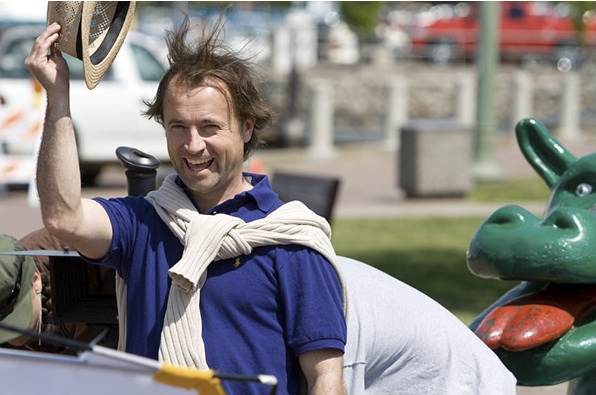
left to right: David Nykl, someone's back, beast

The Beast of Bottomless Lake has been sold to Superchannel and has a DVD release, so to celebrate, the Kelowna-lensed feature will be shown at the Denman Cinema July 15 with cast members in attendance.

6:30 doors
7:30 short films (including Super-Anon with Debra Sears, Chy Liu, Mark Lewis)
between 9:00 and 9:30 The Beast Of Bottomless Lake

Pacific Theatre fans (not to mention Stargate: Atlantis fans) may remember David Nykl - Refuge Of Lies, 12 Angry Men, Mercy Wild, even back to I Am The Brother Of Dragons and Say No Max - who stars as Dr Paul Moran in the feature.

website

Tickets: $15 in Advance Only (tickets cannot be sold at the door due to liquor license regulations), online or at the Denman Cinema box office

Wednesday, June 29, 2011

watching for... lamb of god

"Diablo Cody, the writer behind Juno, will make her directorial debut with Lamb of God. The comedy follows a young conservative religious woman who loses her faith after a plane crash, decides to go to Las Vegas to live the life of a sinner, and on her journey finds her way back to her faith. The company is fast-tracking the project and wants to begin casting as soon as possible."

edited from Hollywood Reporter

Saturday, June 25, 2011

in a better world

No longer playing in Vancouver. Watching for the DVD release...

A few years back, two equally remarkable foreign films appeared, at around the same time. I never understood why one of them - The Lives Of Others - was seen and celebrated by pretty much everybody, where the other - After The Wedding - went largely unwatched. Perhaps because the Florian Henkel von Donnersmark film won the Oscar: perhaps because it was directed by someone with the irresistable name Florian Henkel von Donnersmark - Oscar bait for sure. I ended up preferring Susanne Bier's neglected After The Wedding, but that could just be my anti-band-wagon-istic tendencies. This much I'll say: alongside Please Give, one of only two films I can think of about philanthropy.

In any case, this time around Bier nabbed the statue, so one can hope her latest lensing will draw the wider audience that the shiny little dude seems to attract.

I finally managed to see the film the other day and recommend it, though it can be tough going at times. It cuts close, in a city still coping with the display of human violence that was the Stanley Cup riot: it's about violence and power, retribution and conscience, on a schoolyard in Denmark and in Darfur refugee camps.

Not only is it directed by Bier, but the screenplay is by Anders Thomas Jensen, who wrote
After The Wedding. Both films are complex, mature, unpredictable, taken up with difficult interpersonal / moral questions. A personal favourite (but definitely not everyone's cup of tea) is the extraordinarily black, extraordinarily bizarre, extraordinarily (Scandanavianly) funny Adam's Apples, also written and directed by Jensen. I really can't escape the impression that he and/or Bier must be Christian, or at least preoccupied with or steeped in Christian faith.  (I see that Jensen/Biers both have roots in the Dogme movement, and have collaborated before, on Open Hearts [2002] and Brothers [2004].)
In A Better World shows only once daily, at 2:30, at the Denman - the last stop for films on their way out of town. And with the demise of Videomatica, I don't know how one will be able to see it once it's gone. So make the effort, before time runs out.


Anton and his wife Marianne are doctors. Much of his time is spent in Africa, where he tends the sick under harsh and even dangerous conditions; she remains at home in Denmark. Now separated, they have two sons, one of whom, Elias, is badly bullied at school — a crisis that endures until a new boy named Christian arrives. At no point does Susanne Bier’s film stray far from the borders of violence, whether it’s the violence of disease, of calculated payback, or simply of insufferable feeling. By and large, the children in the movie cleave instinctively to an Old Testament view of wrongs inflicted and answered, whereas most of the adults, who seem at once weaker and more disciplined, subscribe, at least in theory, to Christian forgiveness. The movie retains grip and grace, and the performances — by the child actors, in particular — quicken the pulse of life. Winner of this year’s Academy Award for Best Foreign Language Film. In Danish.

Anthony Lane, The New Yorker
Susanne Bier on In A Better World: "It's about the distance between being savable and not savable. At what point does redemption become impossible? Is there such a point?"

Friday, June 24, 2011

now playing... tree of life (terrence malick)

PLAYING June 24-30...
Park 4:00 7:00 9:55 | Sat/Sun add 12:50
International Village Fri Sat Sun Mon Tue Wed: 12:45 1:50 3:55 5 7:05 8:05 10:15


Won the Palme d'Or at the Cannes Festival. Kind of the big soul food movie event of the year.

"The story follows a young boy who struggles between being a strong man like his father (Brad Pitt) suggests, or going “the way of nature and the way of grace” like his mother suggests. When he is an adult (Sean Penn) his is still struggling with these two choices as he reaches a pivotal point in his life." flix66

Further notes on Tree Of Life and other Malick films

now playing... bill cunningham new york

CURRENTLY AT THE DENMAN CINEMA
July 1-7, 3:30 daily


Lovely, lovely film. Photography, the streets of New York, and a self-directed man. I think of Ralph Waldo Emerson "On Self-Reliance." I think of the title of that book, "Purity Of Heart Is To Will One Thing." Katie was right: there's even a bit of Soul Food here. Joy, vocation, humility.

“If you don’t take money, they can’t tell you what to do. That’s the key to the whole thing.”

Roger Ebert: "It doesn't matter if you care nothing at all about clothing, fashion or photography. Here is a good and joyous man who leads a life that is perfect for him, and how many people do we meet like that? This movie made me happy every moment I was watching it."

Wednesday, June 22, 2011

tangled | un-tangling the fairy tale of the gospel


Ken Priebe is a Vancouver animator who writes for Hollywood Jesus. He recently gave a sermon at Cedar Park Church based on Disney's Tangled. There's also a written article which covers some of the same themes.