Tuesday, November 24, 2009

Soul Food International Film Festival! MIRROR, MAGNIFICENT OBSESSION, SERAPHINE, MUNYURANGABO, SERIOUS MAN

I hereby officially declare the next seven days the Soul Food International Film Festival. (Well, maybe not so official. It only just occurred to me around 5:00 this morning, and it kind of already opened. Make that The First Non-Annual Unintentional Soul Food International Film Festival of Vancouver. Catchy title, eh?)

The Mirror (Andrei Tarkovsky, 1975, Russia)

What's wrong with me? I wrote up my NOW PLAYING post a few days ago and completely forgot about the Soul Food Double Feature that's been written in my datebook for a month! This Thursday night at Pacific Cinematheque, Andrei Tarkovsky's THE MIRROR shows at 7:15, followed by Douglas Sirk's THE MAGNIFICENT OBSESSION at 9:15.

The Magnificent Obsession (Douglas Sirk, 1954, USA)

The films are also showing separately on other nights this week (see the above links for specific times), but Thursday is the one night that offers an opportunity to view them back to back.

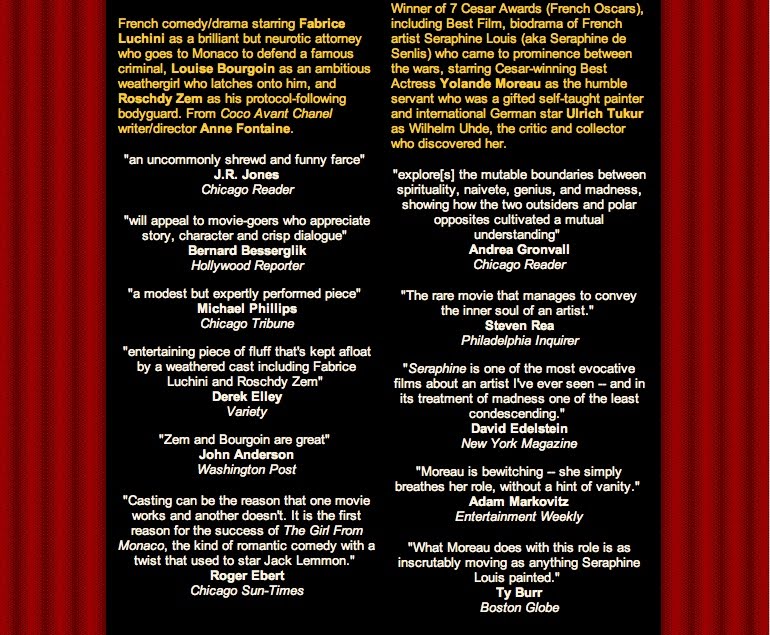
(Seraphine, Martin Provost, 2009, France/Belgium)

That's an opportunity you may want to take advantage of, given that SERAPHINE is running Tuesday through Thursday at The Hollywood (9:15 nightly) and MUNYURANGABO plays Friday through Monday at the VanCity (various screening times).

Munyurangabo (Lee Isaac Chung, 2007, Rwanda)

Toss in viewings of A SERIOUS MAN (and maybe even IT MIGHT GET LOUD and GENTLEMEN BRONCOS?) and you'll have yourself a soul-satisfying cinematic smorgasbord the like of which is unlikely to be seen again. (At least not until we launch our own rather more intentional Soul Food Film Festival...)

A Serious Man (Joel & Ethan Coen, 2009, USA)

For showtimes and venues for all films, check the always helpful Cinemaclock

PS Oh, and my buddy Bryan Coley writes "Go see THE BLIND SIDE to see Sandra Bullock portray one of the best Christian characters ever put on film. Great movie!"

Monday, November 23, 2009

NOW PLAYING: Munyurangabo!!!

Jeffrey O told us to see SERAPHINE, but he insisted we see MUNYURANGABO, his favourite film of the year. And guess what: it's playing the VanCity this coming weekend - as soon as SERAPHINE closes at the Hollywood, in fact. Never rains but it pours.... (Not funny.)

Check out our coverage at Filmwell...

Retrospectives: an essay by Lee Isaac Chung, director of Munyurangabo

A Cinema of Listening and Looking: A Filmwell Conversation with Lee Isaac Chung, Part One

A Cinema of Listening and Looking: A Filmwell Conversation with Lee Isaac Chung, Part Two

M. Leary Review

Thanks for the tip, Mr Chattaway.


MUNYURANGABO
Vancity Theatre Screenings
USA, 2007, 97 min, 35mm
Directed By: Lee Isaac Chung

Friday, Nov 27 at 6:30 pm
Saturday, Nov 28 at 8:30 pm
Sunday, Nov 29 at 4:45 pm
Sunday, Nov 29 at 8:30 pm
Monday, Nov 30 at 6:30 pm

A decade after the genocide that ripped apart Rwanda, how are the children of that country to move forward with their lives? That is the question at the heart of this remarkable debut feature from Lee Isaac Chung, a Korean-American from Arkansas who studied medicine at Yale before he decided to make films.
Ngabo (Jeff Rutagenwa) and Sangwa (Eric Ndorunkundiye) leave Kigali and journey to the home Sangwa left three years prior – they agree to tell his parents they are on a journey looking for work. In fact, they have another, more troubling objective in mind. Sangwa's resolve weakens as he is accepted by his family, but they remain suspicious, even hostile towards his friend, a Tutsi whose parents died in the conflict.

Shot in just 11 days while Chung was teaching filmmaking at a relief mission, with three orphans of the genocide playing key roles, Munyurangabo begins as an apparently straightforward immersion in a specific time and place, but develops into more complex and moving inquiry about the chances for reconciliation.

"Intense empathy courses throughout Chung's first feature, but more remarkable is his ability to foster great kinship between viewer and subject, his largely handheld cinematography generating forceful intimacy with his story's two teenage protagonists [...] as well as a tactile sense of environment. Both qualities run deep in this piercing, authentic, and condescension-free tale." - Nick Schager, Slant Magazine

"Like a bolt out of the blue, Lee Isaac Chung achieves an astonishing and thoroughly masterful debut [...] by several light years the finest and truest film yet on the moral and emotional repercussions of the 15-year-old genocide that wracked Rwanda." - Robert Koehler, Variety

NOW PLAYING: Seraphine! Worse Lieutenant, Serious Man, Ed, Gents, Loud, Wild

Jeff Overstreet said to see Seraphine, sounds like a candidate for Soul Food flick of the year. It's at Videomatica and other local shops, but today's great news is from N.W. Douglas, who tells us it's playing at The Hollywood this week! Best theatre in town, like a time-travel trip to the days of Bogart and Bacall - with prices to match. Thanks, N.W.!

(The random-firing letter scrambler in my brain read
"in French with English subtleties."
Balancing that distinctively French tendency to overstatement, I suppose...)

If you were thinking of taking in Werner Herzog's BAD LIEUTENANT: PORT OF CALL NEW ORLEANS because you saw or heard about Abel Ferrara's BAD LIEUTENANT - which, however foul it may have been, was also completely preoccupied with Christian redemption... Don't rush out to buy tickets. The Guardian reports that "Herzog’s remake jettisons the Catholicism and is lighter in tone.” New at Tinseltown

A SERIOUS MAN continues at 5th Avenue, and continues to stick in my mind. I've posted a Fuller review of this Job-fashioned tale of sixties suburbia from a theology buddy of Robert K. Johnston. (Here's a link to my post-movie musings...)

AN EDUCATION continues at Fifth Avenue and Tinseltown. Director Lone Scherfig did ITALIAN FOR BEGINNERS. I'm told this one involves a tour of C.S. Lewis sites in Oxford as a seduction strategy. Hmmm...

Most wouldn't rush to GENTLEMEN BRONCOS for its theology, but The New Yorker might. Granville 7.

IT MIGHT GET LOUD is about guitar heroes, including The Edge. Denman, daily at 2:30.

And I don't know that WHERE THE WILD THINGS ARE is in any particular sense a Soul Food movie, but I'm starting to think it's bumping UP from the top slot on my 2009 roster. Utterly unique, with monsters rendered as a sullen clique of just-barely-teen-agers, slipping back and forth between unfettered kidness and terrified pseudo-adulthood.


And coming next weekend: Jeff Overstreet's 2009 favourite, MUNYURANGABO. Thanks for the tip, Mr Chattaway!

Eugene Suen on A SERIOUS MAN

Watching the Coens latest, I thought it would be a fine double feature with CRIMES AND MISDEMEANORS - or a triple-bill with the big screen version of JOB VS ECCLESIASTES, if it ever gets remade. Which made me think of Robert K. Johnston, whose marvelous "Useless Beauty: Ecclesiastes through the Lens of Contemporary Film" was the focus of a course he and his wife led at Regent College a few summers ago. Hoping to get his take on the film, wisdom literature dude that he is, I emailed the guy, but he hasn't seen the film. In lieu, passed along this review from the student paper at Fuller Seminary. Eugene Suen co-directs Reel Spirituality with Rob, and is a film producer in his own right. I myself am not convinced that the film is nihilistic, but am also convinced that the film doesn't allow us to readily determine its perspective - a mark of real art, in my opinion. (And actually, I'm not sure Suen exactly agrees with himself on that point, either. It's that kind of movie. Kind of like Solomon...)


A Serious Man - Coen Brothers’ Gravely Serious Comedy

Can we be sure that God is benevolent? Larry Gopnik, the patriarch in Coen Brothers’ compelling new film A Serious Man, wishes he knew the answer. A perfectly ordinary man whose only desire is to lead a perfectly ordinary life, Larry has a house in a pleasant, if bland, suburban community in the Minnesota of the 1960s, a nuclear family of four with a son who is about to have his Bar Mitzvah, and a respectable job as a physics professor that is under review for tenure. All is well until, suddenly and inexplicably, a series of troubles begin to pile up, escalating to a boiling point that sees his life completely falling apart. The desperate Larry is confused and helpless, his fate mirroring that of his many forebears in the faith who, in times of great calamity, struggle to comprehend God’s will and the meaning of the universe.

Naturally, many reviewers have compared the film to the Biblical book of Job. Unlike that ultimately hopeful story, though, A Serious Man offers no consolation about God’s sovereignty, no hopes for a better future, and no comfort about the intrinsic purpose of human existence. Despite its appearance as an absurdist comedy (yes, it is often very funny), the Coens’ tale is bleak through and through, continuing the nihilistic vision from their last two films- the great No Country for Old Men, and the not-so-great Burn After Reading.

There is something profoundly unsettling and powerful about their articulation of a universe ruled by chaos, where clueless people run around like laboratory rats trying to make sense of their predicament when there is none to be made. In the world of No Country for Old Men, humanity has forever lost touch with its more decent impulse; in Burn After Reading, a group of buffoonish characters are caught up in a web of intrigues full of sound and fury that in the end signifies nothing. Tracing back to their earlier films, that same sense of dread about a universe gone awry is also found in works like Blood Simple, Fargo, Big Lebowski, and the eccentric but utterly brilliant Barton Fink (possibly one of the best films about the artistic process ever made. Put it in your Netflix queue now!). As New York Times film critic A.O Scott has observed, the consistency of the Coens’ bleak vision is matched in American cinema only by Woody Allen. While the brothers are formally impeccable- every one of their film has an O.C.D-like precision about them, the universe of their creation is decidedly lacking in a controlling order.

Yet there is also something strangely cathartic about A Serious Man. Having spent their career playing with different genres and geographical settings, the Coens, who grew up in suburban Minneapolis in the 1960s, have finally come home, making a film that is not only sociologically faithful to the environment of their childhood, but one that is also firmly rooted in the Jewish tradition of their upbringing- a tradition that has evidently shaped their sensibility in fundamental ways. A Serious Man, like the works of Woody Allen, thrives on a sense of wry, self-deprecating humor, its worldview unmistakably that of a people who have been outsiders, who know what it feels like to be in exile and persecuted (by others and, seemingly, by God) Moreover, the dry wisdom of the film, which could probably be best summarized by its opening quotation “Accept with simplicity everything that happens to you”, offers for people of faith not a fatalistic resignation to the ostensibly arbitrary course of life, but an acceptance of our finitude. After all, God’s ways are higher than our ways; some things are simply beyond our comprehension. We live and move and have our being in him; he gives, he takes away, and may his name still be praised.

This, however, does not mean one’s suffering will be eased in the meantime. What makes A Serious Man compelling is its ability to evoke a sense of helplessness that all of us have surely experienced at some point in life. Larry’s guttural cry for answers, his desire to comprehend his circumstance, resonates in a world filled with mysteries and injustices. The Coens have often been accused by detractors as cold, analytical misanthropes, but whether or not their new film’s pessimism is an epistemologically warranted position, or merely another case of personal neurosis blown to cosmic proportion, is beside the point. As it stands, A Serious Man is an impeccably made comedy that offers some gravely serious reflections on what it means to be human. In the presence of the slings and arrows of outrageous fortune, sometimes you can’t do anything except have a sense of humor.


Eugene Suen is a film producer and the Co-Director of Reel Spirituality Institute, the center for theology and film at Fuller Theological Seminary

Wednesday, November 18, 2009

THE RAPTURE (1991, USA, Tolkin)


THE RAPTURE (1991, USA)
Rapture (rap' chur) 1. ecstatic joy or delight. 2. a state of extreme sexual ecstasy. 3. the feeling of being transported to another sphere of existence. 4. the experience of being spirited away to Heaven just before the Apocalypse.

This bizarre shaggy dog story is as sexually and spiritually explicit a film as you're likely ever to see. Mimi Rogers (in what may be the performance of her career) portrays a telephone information operator whose off-hours sexual adventures can no longer mask an agonizing spiritual emptiness. When she overhears the secretive lunch-room whisperings of some drably religious co-workers, this desperate, hungry woman begins to be drawn toward a potentially authentic Christian conversion in the context of a cultish end times sect.

Early in the film Sharon tells a casual sex partner that if she has any limits, she hasn't found them yet. Perhaps that's just as true of director / writer Michael Tolkin, who adapted this uncompromising film from his own novel – he never flinches in following this bizarre, compelling premise to its inevitable, utterly unpredictable conclusion. And the route he follows in getting there is as idiosyncratic as the story he's chosen to tell – just when I thought this thing was a cross between a Shannon Tweed direct-to-video sex flick and a Jack Chick evangelistic tract, I began to wonder if it wasn't going to end up in CLOSE ENCOUNTERS territory, with a bit of Ingmar Bergman and Joel Schumacher thrown in for good measure.

In saying that, I don't mean to be dismissive about the film. Its stylistic excesses come from an abundance of ambition and imagination rather than a poverty of taste or craft. Bear in mind that this movie comes from the same mind as the morally searching CHANGING LANES, the similarly audacious "lets take this idea to its absolute limit" novel that begat Robert Altman's masterful and sophisticated film, THE PLAYER, or the go-for-broke satire of THE NEW AGE.

Given that the film opens with explicit sexual material, it will be no surprise that it doesn't feel obliged to end up in any particularly orthodox theological place. But the films apparent heterodoxies are in tension with the authenticity of this woman's spiritual search, however psychologically troubled she might be. And however church-skit embarassing I found some of the evangelistic dialogue – though I'd suggest that these dichotomies are the film maker's primary strategy,k to constantly confront us with unsettling and dissonant elements that both provoke and confound our preconceptions.

However rambling the film's structure, it ultimately seeks the very core of the Christian faith, asking blunt questions about the only question that matters: the love of God – our love for him, and his for us. I found the film's final assertion unsatisfying due to what I took as a self-congratulatory lack of nuance, patting itself on the back for asking Big Questions while implying only Small Answers. Until it occurred to me that the untenable situation the character finds herself in is almost entirely of her own making. So just what is this Michael Tolkin guy saying, anyway?

I can think of only two other explicitly religious films that are quite this strange, and only one that has anything like its earnestness of purpose. GOD TOLD ME TO is equally quirky, but is finally nothing more than a confused Godsploitation flick. Brian Moore charts equally strange spiritual waters with serious intent in COLD HEAVEN, but that film is seriously marred by grotesquely bad acting. It seems THE RAPTURE stands at the pinnacle of its provocative genre – however small and eccentric that genre may be.


Available at Videomatica

Wednesday, November 11, 2009

Nov 10-24: 50% off Criterion disks

Starting November 10, all Criterion Collection titles will be 50% off the list price at Barnes & Noble, both in stores and online. This special promotion encompasses all titles and will run until November 24. (NOTE: Titles on preorder with street dates after 11/23 are not eligible for the discount.)


And if you're wondering what to buy, you could do worse than starting with the newly-released WINGS OF DESIRE. Here's an essay by director Wim Wenders, written after the making of the film. (Beware spoilers)

Nov 21 25 26: Tarkovsky's THE MIRROR at Cinematheque!


THE MIRROR (Zerkalo)
USSR | 1974 | Andrei Tarkovsky
35mm PRINT!

Pacific Cinematheque
Saturday, November 21, 2009 - 7:15pm
Wednesday, November 25, 2009 - 9:35pm
Thursday, November 26, 2009 - 7:15pm

Cinematheque: Andrei Tarkovsky’s visually sumptuous fourth feature is the great director’s most personal and poetic (and Proustian) film. The Mirror offers an idiosyncratic history of twentieth-century Russia, in the form of a poet’s fragmented reflections on three generations of his family. The poems used in the film were written and read by the Tarkovsky’s own father (the poet Arseny Tarkovsky); Tarkovsky’s mother appears in a small role as the protagonist’s elderly mother. In a dual role, actress Margarita Terekhova is both the protagonist’s wife and his mother as a younger woman. “The Mirror is Tarkovsky’s central film, and his most personal one, although it might be better described as a transpersonal autobiography. Dreams and memories of an individual protagonist (who is never seen on screen) blend with dreams and memories of the culture. The generations of one family mingle. The Mirror achieves something which is uniquely possible in cinema but which no other film has even attempted: it expresses the continuity of consciousness across time, in a flow of images of the most profound beauty” (Amnon Buchbinder). Colour and B&W, 35mm, in Russian with English subtitles. 106 mins.

"Profoundly intimate . . . one of the rare completely achieved films of autobiography." Mark Le Fanu
"Perhaps Tarkovsky’s greatest work." Film Society of Lincoln Center
"An essential film, an extraordinarily beautiful movie." Village Voice


THE MIRROR is available on DVD at Videomatica

Friday, November 06, 2009

Nov 17 20 22 26: THE MAGNIFICENT OBSESSION, VanCity

Lloyd C. Douglas was a pastor at a series of Lutheran, Congregational and United churches before starting a prolific writing career at the age of 50 with The Magnificent Obsession (1929), the first of several of his novels to eventual reach the silver screen. The most notable film treatment of a Douglas story is Douglas Sirk's 1954 Technicolor extravaganza, which was recently released on DVD by Criterion. (Director Todd Haynes pays tribute to Sirk's fifties "weepies" with the extraordinary 2002 film FAR FROM HEAVEN.) Now OBSESSION plays the big screen in all its magnificence: thanks, Cinematheque!


MAGNIFICENT OBSESSION
Pacific Cinematheque
Tuesday, November 17 - 1pm
Friday, November 20, 2009 - 9:35pm
Sunday, November 22, 2009 - 7:15pm
Thursday, November 26, 2009 - 9:15pm

Director: Douglas Sirk
Cast: Jane Wyman, Rock Hudson, Agnes Moorehead, Barbara Rush, Otto Kruger

VanCity: Douglas Sirk described Magnificent Obsession as the "craziest" of his stylish, sumptuous, subversive melodramas. The film’s delirious plot has Rock Hudson as an irresponsible playboy who indirectly causes the death of a doctor and blinds the dead man’s widow, played by Jane Wyman. Sirk's Magnificent Obsession was the director's first big commercial success, and a remake of the 1935 melodrama of the same name, which was based on the 1929 novel by pastor Lloyd C. Douglas. "It was the most confused book you can imagine," said Sirk. "My immediate reaction to Magnificent Obsession was bewilderment and discouragement. But still I was attracted by something irrational in it. Something mad, in a way — well, obsessed, because this is a damned crazy story if there ever was one."

More VanCity: Douglas Sirk’s extravagant 1950s melodramas — All That Heaven Allows, Written on the Wind, Imitation of Life et al. —constitute one of the most piercing critiques of American society to be found in classic Hollywood cinema – an achievement largely unappreciated by “serious” critics of the day because it came in the form of a much derided (but popular) genre: the “women’s picture,” or “weepie.” Sirk described Magnificent Obsession as the “craziest” of his films, and even that might have been an understatement. The film’s delirious plot has Rock Hudson as an irresponsible playboy who indirectly causes the death of a revered philanthropic doctor, blinds the dead man’s widow (played by Jane Wyman, the former Mrs. Ronald Reagan) in another accident, and then becomes a world-renowned surgeon in an effort to restore her sight — falling in love with her, of course, in the meantime. Magnificent Obsession was Sirk’s first big commercial success, and the first in the series of gloriously stylish, over-the-top, colour-drenched melodramas on which the bulk of his enormous critical reputation rests. The film demonstrates “Sirk’s daring, his willingness to take on the most outrageous material and work on it with the deep irony which was one of the most important gifts he brought with him to Hollywood” (Jon Halliday). “Extraordinary . . . Sirk’s films are something else” (Chris Petit)


THE MAGNIFICENT OBSESSION is available on Criterion DVD at Videomatica

Thursday, November 05, 2009

A SERIOUS MAN: Questions For Further Study


1. What is that quote at the start of the film? From a non-Jewish source? How does it shed light on the Jewish world of the film? Specifically, how does it relate to the theology of the first rabbi?

2. How does the Dybbuk story relate to the rest of the film?

3. What is the signifcance of the story of the goy’s teeth? Do you have anything written on the inside of your teeth?

4. Gopnik is dismissive of the stories / fables used to illustrate the principles of physics which he teaches. He claims not to understand the stories, but to put all his faith in the mathematics. How does this relate to the mysterious fables related in the film: the dybbuk, the goy’s teeth?

5. What’s the difference between Gopnik’s blackboards full of formulae, which don’t seem to help him to much, and Uncle Arthur’s notebook full of formulae, which seem to get him in serious trouble? Did anybody else think of A Beautiful Mind?

6. Do the three rabbis correspond to Job’s comforters?

7. What is the Grace Slick quote? What is its function: to undermine the rabbi as a source of wisdom, or to affirm something about popular culture? How does it relate to the warm affirmations of the son’s bar mitzvah, which are oblivious to the son’s actual state of mind? Is all that stuff cynical? Is the film cynical? Is Solomon cynical?

8. What was that science fiction TV show, with the brain in the vat?

9. Think about the recurring phrase “a serious man.”

10. What is the significance of the simultaneity of the two car accidents?

11. Why do critics say there’s no God in this film apart from the film-makers, and they are a cruel God? Is the God of the film cruel? Is He any different than the God of biblical wisdom literature? What does Robert K. Johnston think?

12. One rabbi contrasts a Jewish notion of the afterlife – “Abraham’s bosom” – with the Christian idea of heaven, which he compares to Canada (thereby showing great wisdom). Gopnik sends Uncle Arthur to Canada in a canoe. Or tries to. Significance?

13. If Canada is heaven, is North Dakota hell, Vanity Fair, the place of temptation and damnation? Isn’t Fargo in North Dakota? What would Marge Gunderson say about this?

14. Did this film make anybody else think of Crimes and Misdemeanors?

15. If you had a neighbour’s wife like Mrs. Samsky, would you covet her? Would you be more or less inclined to adjust the TV antenna whenever your son complained about poor reception? Did you like F Troop when you were a kid? I did.

TO BE CONSIDERED ONLY AFTER VIEWING THE FILM

16. Think about the variations on the phrase “I didn’t do anything.” A protestation of Gopnik’s innocence: “I don’t deserve this, I didn’t do anything wrong”? A perhaps unconsious confession of sins of omission? How does this assertion relate to Gopnik’s dreams? Is he a good man for not having actually had sex with his neighbour’s wife, though clearly he was tempted? Is he a bad man for not having actually taken his brother to Canada, sending him off with an envelope of cash? How good are we for not doing the wrong we dream of doing? How bad are we for not doing the good we dream of doing?

17. What’s the difference between using the bribe money to bless his brother, or using it to pay his legal bills? Does the apparent choice to do the latter somehow lead to the bad things that happen to this “good” man? Or is it foolish to look for cause and effect in this? Does this relate to Gopnik’s lectures on uncertainty, etc?

18. How does the tornado relate to the flood at the end of O Brother, Where Art Thou? Both seem “acts of God”, the latter clearly an affirmation of the validity of faith (as represented by the blind prophet) and a refutation of the “wisdom of men” (as embodied by Everett), the former seemingly a reversal of the apparent restoration of divine blessings which would more closely parallel the resolution of the biblical Job story.

Tuesday, November 03, 2009

NOW PLAYING: Wild Loud Serious Education

THE BIG LEBOWSKI tonight only at the VanCity, 7:30.

Carol, Max, KW

2009: the year of the Amazing Kids' Movie? I just saw WHERE THE WILD THINGS ARE, and that's one unpredictable, substantial, exotic piece of work: Spike Jonze, Dave Eggers, flings itself with reckless abandon on the same wide-eyed year-end pile as UP. My WILD enthusings evoke insistences I see CORALINE: eager to comply. Awaiting frantically FANTASTIC MR FOX: great extended profile of director Wes Anderson in Nov 2 New Yorker whets the appetite further. And I'm told CLOUDY WITH A CHANCE OF MEATBALLS is fun. Nothing wrong with fun. In a sometimes weary grey autumn, I'd pay fifteen buck for fun.


Look what Jeff Overstreet says about AN EDUCATION, from the director of my beloved ITALIAN FOR BEGINNERS: "The rising buzz about Carey Mulligan’s star-making performance, not to mention the compliments paid to the great Alfred Molina for his supporting role, have made me impatient to see Scherfig’s new film. The fact that it’s about a teenage girl from suburban London being baited by an older man (Peter Sarsgaard) into a wild new life on the promise that he’ll give her a C.S. Lewis sightseeing tour of Oxford makes it seem that much more intriguing."


Plenty of critics are dismissive of A SERIOUS MAN, but it seems to me most Coen brothers flicks get chilly receptions, then grow on us. And many of my Soul Food-ish movie pals hail this Job story set in Midwestern Jewish subculture, c. 1967.


Soul Foodies are often U2 fans (you should have seen my facebook news feed a week ago!): note the daily 2:30 Denman matinees of IT MIGHT GET LOUD, a guitar rock-doc featuring The Edge.

Also at the Denman for the time being, JULIE & JULIA (one of my '09 faves) 4pm daily, and 500 DAYS OF SUMMER (which I liked a lot) 7:00 nightly. J&J also a double feature at the Hollywood with the intriguing DISTRICT 9 Tue/Wed, the latter with a couple shows daily at Granville 7.

Wednesday, October 28, 2009

Horton Foote: "The Cumulative Momentum of the Mundane"


Excerpted from
LUCKY MAN: Horton Foote's three acts
by John Lahr
The New Yorker, October 26, 2009
"If a poet knows more about a horse than he does about heaven, he might better stick to the horse," Foote was fond of saying, quoting the father of his favorite American composer, Charles Ives. "Someday the horse might carry him to heaven."
. . .
Crucially, more by accident than by intention, he found his way into Method acting lessons with two recently arrived emigres from Stanislavsky's Moscow Art Theatre, Andrius Jilinsky and Vera Soloviova, who taught that "to create truth on the stage, you must be acquainted with your own truth." (To Foote, this strategy became bedrock; throughout his life, he maintained an aesthetic of unvarnished narrative truthfulness.) By degrees, he came to know other Method acolytes, among them Lee Strasberg, Stella Adler, Franchot Tone, Clifford Odets, Sanford Meisner, and Tennessee Williams.

Foote thought of Williams, who was eight years older, as "artistically my big brother." He followed his lead in rejecting the schematic ideological drama of the thirties and writing plays that embraced the personal instead. . . .

As writers, Williams and Foote were opposites. Williams was a hysteric who wanted to seduce the audience with the truth of his lament; Foote's plays bore witness to the emotional truth of history. Williams wrote out of a sense of absence, Foote out of a sense of fullness. Williams was a romantic who destroyed himself for meaning; Foote was a conservative who made meaning of the world he sought to preserve. In his storytelling, Williams was melodramatic and extravagant; Foote preferred a sly, understated simplicity. "I've tried to be more theatrical, more sensational. It's not my style," he said. "I admire Shakespeare greatly, and deeply love to read him, but his is not my favorite type of theatre. Often it embarrasses me and also I don't believe a lot of it." In Foote's plays, the big dramatic events happen offstage. Foote examined the ripple, not the wave. He was a quiet voice in noisy times. . . .

Lillian Gish in Trip To Bountiful, Broadway

Foote's plays "The Chase" (1952) and "The Trip To Bountiful" (1953) were staged in New York, but received little attention. Unlike the major playwrights of the period – Williams, Arthur Miller, William Inge – he had no axe to grind, no moral posture to strike, no rebarbative wit to peddle, and none of the sensational theatrics that thrilled commercial audiences. Things happened in Foote's stories, but nobody was blowtorched, castrated, raped, eaten alive, or snowed in with a beautiful woman; nor did anyone commit suicide for the insurance money. Foote could not make a living or a reputation on Broadway. . . .

To Kill A Mockingbird

"Keep your ear to the ground and concentrate on honesty," Williams wrote to Foote in 1944. Throughout his career, Foote did just that. From the ordinary, he teased out a subtle song, which was at once true and tender. In his screen adaptation of Harper Lee's "To Kill A Mockingbird," for instance – "a work of such quiet and unobtrusive excellence that many people have commented the film's dialogue was lifted chapter and verse from the novel. This is simply not so," Lee wrote. . . .

Robert Duvall, who made his film-acting debut as Boo Radley, the subnormal next-door neighbor who saves the lives of Finch's children, and who appeared in six other Foote projects, including an Academy Award-winning performance as the fallen country singer Mac Sledge, in Tender Mercies (Beresford, 1983), compared Foote's dialogue to "sandpiper prints." "They're very delicate," he said. "It's very deep, very specific. His work you have to let lay there and find its own impetus."

Tomorrow

Nowhere in Foote's canon is the cumulative momentum of the mundane more powerful than in Tomorrow (1972), Foote's inspired film adaptation (based on his 1968 stage version) of a 1940 Faulkner short story. A low-budget masterpiece, directed by Joseph Anthony, the movie flashes back from a murder trial that has ended with a hung jury, and is narrated by the defense lawyer, who can't fathom why one holdout on the jury – a plainspoken Mississippi farm laborer named Jackson Fentry (Duvall) – wouldn't vote to acquit an upstanding rancher, H.T. Bookwright (Jeff Williams), who is accused of murdering a cattle thief and lowlife, Buck Thorpe, who was running off with his daughter. . . .

The story that unfolds in flashback . . . is entirely Foote's invention. . . . Foote's uncanny ability to expand another writer's narrative was an offshoot of his ability to listen. (Faulkner liked Foote's version so much that he shared his royalties with him.) In Faulkner's tale, Foote heard the themes of enduring suffering and enduring love, on which his own plays ruminated. "I've known people the world has thrown everything at . . . and yet something about them retains dignity," Foote said. . . .

Foote, who rebelled against the fire and brimstone of the Methodist reaching he grew up with, became a Christian Scientist in 1953. "I am deeply religious but I never write from that point of view," he said. "I don't proselytize." Foote believed that "spiritual values lead you to hunger for more spiritual values." The placid surfaces of his stories conceal an undertow of the eternal. Hymns frequntly signal this immanence. In "The Trip to Bountiful," for instance, Carrie Watts's hymn-singing implies her spiritual restlessness and her longing for transcendence. . . .

In his own household, Foote often repeated the Christian Science axiom "Divine love always has met, and always will meet, every human need." He read the Christian Science Quarterly and did his Bible lessons every day. "I think it sustained him," his daughter Hallie said. "He felt that there was something bigger than he was out there, and he respected that. It encouraged him to follow his instincts rather than impose something on them." The constant flow of his work was evidence of his faith, which worked as an antidote "to being fearful or shut down," Hallie said. Foote himself gave God credit for his literary productivity: "That doesn't come from me – that is, I reflect qualities of God," he said. In an undogmatic way, his plays are more often than not demonstrations of spiritual grace; they try to trap a sense of the miraculous in the ordinary.

Tender Mercies

In Tender Mercies, for instance, the newly baptized Mac Sledge is saved from the hell of alcoholism and the waste of his life and talent by the love of a woman and her son, who literally and symbolically give him a new song. In "Bountiful," Carrie Watts tells the sheriff who takes her the last miles of her odyssey, "Before I leave this earth, I'd like to recover some of the dignity . . . the peace I used to know." She finds salvation not, as expected, in the land but in the journey. She can now join her family and live out her days in harmony, instead of in resignation. That internal harmony also defined Foote; of his almost unnerving calm, Harper Lee said, "He's like God, only clean-shaven." . . .

Because he broke no new artistic ground and staked no intellectual claims, he has only a minor place in American theatre history. But, within the limits of his compassionate vision, he was an expert storyteller, who achieved something that no other modern American playwright has: he had not only a second but a third act. At present, his screenplay Main Street is in production; "The Orphans' Home Cycle" is in performance; a biography, "Horton Foote: America's Storyteller," by Wilborn Hampton, ahs just been published; and The Horton Foote Review: The Journal of the Horton Foote Society continues to debate the issues and nuances of his oeuvre. "He had a gift and an ear," Hallie said. "There's a side of me that feels like that was a kind of a divine thing. He was lucky."

Tender Mercies

Snarky about television


In my new post at Filmwell, I get snarky about television...

Thursday, October 22, 2009

Anthony Lane on THE INVENTION OF LYING


Anthony Lane, The New Yorker, October 12 2009

The new Ricky Gervais film, THE INVENTION OF LYING, postulates a world in which no one has ever told a lie. We know this because the hero tells us all about it in an opening voice-over. It is the first, small warning sign that the movie may not be firing right. . . One delight of THE TRUMAN SHOW was the onus it placed on viewers from the start, both daring us and trusting us to work out, at our own speed, just what the hell was going on in that spotless seaside town. No such joy from Gervaise. . . who seems to have mislaid the T-shirt that is handed to every first-time movie director - the one that reads "Show, Don't Tell." That is a shame, because the conceit itself is ripe with possibility. . . .

We have heard something similar before, in LIAR LIAR (1997), which presented Jim Carrey as a lonely blurter in a mendacious world. Here the situation is reversed. Everyone dwells in veracity except for Mark, who, one day, at a bank, suddenly tells a lie; we watch it happening, inside his brain, a rare synaptic spark, and it nets him five hundred dollars. . . . He comforts his aged mother as she fades away in a nursing home. . . with an off-the-cuff account of a radiant afterlife, complete with mansions, where she will continue to exist. "Go on," one of the nurses urges him.

So he does, and THE INVENTION OF LYING promptly lurches into another gear, with Mark finding fame as a Moses figure, with a hint of John the Baptist. The difference is that those men believed what they foretold, whereas Mark makes it up as he goes along, scribbling nostrums on whatever comes to hand. "Everything you need to know is written on these pizza boxes," he declares to a crowd of people gathered outside his apartment, telling them of a mysterious "man in the sky" who controls their destinies, and promising them eternal ice cream if they behave well on earth. Audiences here should be reminded, at this point, that Gervais found his fame on the BBC, with "The Office" and "Extras," and that the execration of religious faith, specifically Christianity - plus a reflex sneer at the fools who fall for it - has, in the past decade, become the default mode of British cultural life. It makes sense, I suppose, for Gervais to use his film to air such mockery, if spiritual belief genuinely strikes him as a lie like any other; the plan would carry more weight, however, if he didn't use the rest of the film to air his transcendent belief in Ricky Gervais. . . .

Toward the end, THE INVENTION OF LYING becomes almost a one-man show; we find ourselves in a traditional church (who built that?), with the Cross digitally removed from its steeple and an icon of Mark, with outstretched arms, above the altar. So, the sweet best friend with the snub nose not only gets the girl; he gets to play the man in the sky. Talk about invention.

Tuesday, October 20, 2009

NOW PLAYING: You The Living, A Serious Man, It Might Get Loud

Quick note about three Soul Food-ish titles playing this week.


YOU, THE LIVING is at Pacific Cinematheque Thursday night only, 7:30. More Nordic strangeness with distinctly Biblical moments, from the creator of SONGS FROM THE SECOND FLOOR. I saw it at VIFF last year or the year before, and liked it immensely.


Jeff Overstreet is recommending A SERIOUS MAN, the Coen brothers' latest, a Book Of Job story set among the Jewish community in the 1960s midwest. TinselTown (3:00 4:15 5:30 6:45 8:00 9:15 10:30) and the Park (4:00 7:00 9:20).


Not that there's any straight up Soul food, but Soul Foodies are often U2 fans, and The Edge is featured in IT MIGHT GET LOUD, a celebration of the rock guitar. TinselTown 2:50, 5:10, 7:40, 10:00

Thursday, October 15, 2009

Retro-Modern Movie Posters

Marvelous post at My Modern Met blog, featuring new posters for well-known films created by a number of graphic artists, in a retro / modernist vein. Gorgeous work! Here's a sampling...


Monday, October 12, 2009

Favourite Films, 2000-2009: First Draft


I don't think the first decade of the new millennium actually ends until 2010 is over, does it? But people are starting to tally their "Best Films Of The Decade" lists, and of course I can't resist.

It actually makes a certain kind of sense to consider as a group any films released after 1999, if only because 1999 was such a remarkable year at the movies. Remarkable year for Soul Food Movies, in fact, but generally speaking, a watershed.

So I scanned some lists and started tallying the movies of the past ten years that have entered my personal pantheon of beloved films. For starters, here we go.

The first three are easy. After that, it's going to take some thinking. (And of course, there will be plenty of contenders yet to be released in 2009).


1. Dogville
2. The Son
3. Pan's Labyrinth

About A Boy
About Schmidt
Adam's Apples
Adaptation
After The Wedding
Amelie
The Assassination of Jesse James
Born into Brothels
Capote
Dirty Pretty Things
The Diving Bell & The Butterfly
Gosford Park
High Fidelity
I'm Not There
In Bruges
Into The Wild
Italian For Beginners
The Lord of the Rings
The Man Without A Past
Matchstick Men
The Merchant Of Venice
Napoleon Dynamite
O Brother Where Art Thou
Once
Open Range
Passion of the Christ, The
Pieces of April
Rivers & Tides
Silent Light
Son Of Man
The Station Agent
U23D
Up
Ushpizin
The Woodsman

Oct 15 VIFF Pick: The White Ribbon (Haneke)


The White Ribbon ["Das Weisse Band"]
(Austria , Germany , France, Italy, 2009, 144 mins, 35mm)
Mon, Oct 12th 9:00pm | Empire Granville 7
Thu, Oct 15th 3:00pm | Empire Granville 7

Winner of the Palme d'Or, Cannes 2009. In a German village in the early part of the last century, something is terribly amiss with the children. As always, Michael Haneke's take on the human condition resists easy definition. "A rich, detailed work pregnant with the sinister undertones and evil deeds for which the filmmaker's work is legendary..." - Screen International
With this new film, Haneke returns to his classic themes of guilt, denial and violence as the mysterious symptoms of mass dysfunction. The White Ribbon is a period film set in a secluded northern German village on the eve of the first world war, shot in a pellucid monochrome, impeccably acted, and directed with this filmmaker's icily exact rigour and severity.

An isolated community is shaken by unpleasant, inexplicable events: a razor trip-wire fells the local doctor on his horse, and he is badly injured. The landowning baron's son is found, bound and whipped. A boy with Down's syndrome is horribly abused. The white ribbon of the title is a badge of mortification: the pastor's children must wear it as a reminder of their sinful state and need for purity. But of course it is effectively the symbol of the retaliatory violence to come.

Like Haneke's earlier film HIDDEN, this is to some degree about the return of the repressed. Unlike that movie, however, The White Ribbon is not about the repercussions of a single buried event, but a continuous diseased process, in which those without power... are in a permanent state of futile rebellion against authority, expressed in spiteful acts of anonymous nastiness... The White Ribbon has an absolute confidence and mastery of its own cinematic language, and the performances Haneke elicits from his first-rate cast, particularly the children, are eerily perfect. The Guardian


The film just played in the New York Film Festival. There's a fine profile of the director in the Oct 5 New Yorker: here are some clippings...


And here's a link to something I wrote on my last encounter with Herr Haneke, at VIFF 2006 - TIME OF THE WOLF - available at Videomatica, as are most of the director's films.

Oct 15 VIFF Pick: Letters To Father Jacob


Letters to Father Jacob [Finland]
Thu, Oct 15th 6:20pm
Empire Granville 7

A simple but transcendent story about faith and human frailty achieves a state of grace in Letters to Father Jacob. Centring on a tough ex-con temporarily serving as an amanuensis for a blind pastor in rural Finland, director Klaus Härö's magisterial control over the proceedings renders predictable material into something fresh and heart-rending, particularly for thoughtful audiences.

Surprised at being pardoned 12 years into a life sentence, hard-bitten killer Leila (Kaarina Hazard) takes the prison warden’s suggestion and winds up at the ramshackle parsonage of Father Jacob. The elderly man needs a secretary to pursue his main joy in life: answering the letters of those who write asking for his help. Although Leila regards the pastor’s correspondence as pointless, it ultimately plays a role in her own redemption and self-forgiveness.

In what’s essentially a perfectly cast two-hander, both leads provide remarkable, exquisitely calibrated performances. The heavyset masculine-looking Hazard (a feminist academic and writer) makes one feel a lifetime of repressed anger in Leila’s stomping and banging, while Nousiainen (a TV vet) movingly conveys Jacob’s anguish and vulnerability... Working in wide screen, prize-winning cinematographer Tuomo Hutri supplies director Härö’s trademark lush visuals, while an affecting piano score gives extra weight to big emotional moments.

Richard Brody on CREATION


From The Front Row, Richard Brody's New Yorker movie blog...
"Macy Halford worries that religious conservatives in America are getting in the way of movie distributors picking up CREATION for U.S. release. She cites ... the film’s producer, Jeremy Thomas, and anti-evolution invective spewed about the film on conservative Christian Web sites, but it seems to me that Thomas is just doing his job as a producer: he’s trying to shame or flatter a distributor into ponying up for it.

"Could it be that Thomas is holding out for a U.S. distribution deal rich enough to require a large national release? In other words, could this really be about money rather than religion? And one more thing; look at the trailer:


"Doesn’t it look bland? There are lots of films from around the world that don’t have American distribution, many of great artistic significance. I’d like to see a movie about Darwin, about the work that went into the discovery of evolution, and, for that matter, about the controversy it still arouses. Is “Creation” the one we’ve been waiting for? I have my doubts."

Thursday, October 08, 2009

Oct 11-17: Homelessness Action Week, THE CATS OF MIRIKITANI & THIS DUST OF WORDS


Soul Food friend Judy Graves is the person at the City of Vancouver who is our point person for homelessness. (Some people say she's responsible for homelessness in Vancouver, but I'm not sure we can blame her exclusively). She's not just an office worker: Judy spends much of her time in the streets and alleys and parks and shelters, and knows by name pretty much everybody you've ever given a loonie to.

Anyhow, she sent this note...


Steven Ng is showing my two personal favourite homelessness movies October 16. CATS OF MIRIKITANI and THIS DUST OF WORDS. If you haven't yet watched these two documentaries - I strongly recommend that you make this your Homeless Action Week treat to yourself.

Each movie gives us a lifechanging shift in world view. Each gives more questions than answers. Both impact my day to day work profoundly.

Judy

(CATS is available at Videomatica)

There will also be a related film event on the North Shore...


Tuesday, October 06, 2009

AMADEUS (1984, USA, Milos Forman, Peter Shaffer play and screenplay)


Whilst my father prayed earnestly to God to protect commerce, I would offer up secretly the proudest prayer a boy could think of. “Lord, make me a great composer! Let me celebrate your glory through music - and be celebrated myself! Make me famous through the world, dear God! Make me immortal! After I die let people speak my name forever with love for what I wrote! In return I vow I will give you my chastity, my industry, my deepest humility every hour of my life. And I will help my fellow man all I can. Amen and amen!”

What extraordinary writing! Economy, irony, implication – volumes are spoken in this one brief speech, themes sounded that will be repeated and inverted in subtle variations throughout the film. Salieri, speaking at the end of his life, recounts the childhood prayer that set the course of his life. He critiques the self-serving prayers of his father, a merchant, yet his own prayer is every bit as mercenary: he isn’t confiding in a loving Father, he’s unilaterally setting the terms of a quid pro quo contract, and presuming that makes it binding on both parties. When he calls the prayer “proud” he means it was noble, but we hear the irony as he names the cardinal sin that will come to define him. He pledges a chastity he will readily cast aside when he decides God isn’t keeping His end of the bargain, he promises a humility that will only ever be evident in recognizing – and coveting, and seeking to destroy – another man’s greater gift. The musical gift of Wolfgang Amadeus Mozart.

These vows amuse us at the same time as they trouble us. They are childish, speaking a conventional piety as naïve as a Boy Scout promise – “and do a good turn to somebody every day.” But the fact the man who recounts them has never outgrown them, that he repeats them without recognizing their vanity, is chilling. What we smile at in the child, we recoil from in the man. By the time Salieri whines “all I ever wanted was to sing to God,” we know better.

Salieri believes he yearns only for eternity: we recognize a thoroughly earthly-minded man lusting for a merely earthbound immortality. Cruel justice lies in the fact that his prayer will in fact be answered. The now-aged man’s final speech picks up this opening theme and plays it back in an ironic inversion, and we realize that he is in fact remembered centuries after his death. People are writing plays and making movies about him. How pathetic.

When the young Salieri’s father chokes to death on a piece of fish and the self-consumed lad is sent away to study music, he takes it as a miracle – “I knew God had arranged it all; that was obvious” – and it is all clear: this God will do Salieri’s bidding, and even murder is an acceptable means to that end. How tragic.

Indeed, for all its energy and brilliantly entertaining wit, this film is a classic tragedy: not the story of Mozart at all, except indirectly, but the story of a man who could have been noble, or at least godly, but whose tragic flaw brings not only his own ruin, but the ruin of those around him. And this is a singularly theological tragedy: Salieri's tragic flaw is "the eldest sin of all, that struck down the morning star from heaven." The deadliest of the deadly sins.

“Amadeus” means “beloved of God.” Celebrated playwright Anthony Shaffer – preoccupied (like his playwriting twin brother, Peter) with twinning, and with the clash between conventional religiosity and a wilder, more dangerous communion with the divine – imagines in this not-quite-historical story something of a Cain and Abel tale, a Jacob and Esau rivalry. He considers what it may have been like to labour as a moderately skilled composer in the shadow of one of the sublime musical geniuses of all time. To believe oneself cursed because of another’s greater measure of blessing.

One smart friend is convinced the film is anti-religious, and certainly the image of God the film conveys is thoroughly unappealing. But perhaps the film is not so much anti-religious as it is the study of an anti-religious man. Bear in mind that this is Salieri's story, his version of event. We see everything through his jaundiced eye – including God. If his deity seems cruel, withholding, manipulative, capricious, punishing, are we seeing a true image of the Father, or only one that Salieri makes in his own image (or that of his own father?).

Or perhaps it is even closer to the truth to say that the film is not anti-religious, but rather anti-religion - if by religion we mean the things we do to please God. Biblical scholar Robert Jewett reads immense theological insight in the film, arguing that it conveys “a distinctive and little-understood aspect of the theology of Romans”: that sin, properly understood, has little to do with the conventional sense of sin as indecency – Mozart’s arrogance and crudity, his irresponsibility and unwillingness to conform to social niceties – and everything to do with the self-deception of the self-righteous man who would set himself against God. Who would set himself up as God.

The film doesn’t gloss over the sins of Amadeus – as winsome as he can be, he also acts out his own high-flying arrogance, lives in deadly thrall to his own vices. “There is none righteous, not one.” But he possesses a humanity, ultimately a vulnerability, that leaves room for the glories of grace Salieri can hear in “The Marriage Of Figaro” but not live. That can find the humility to ask forgiveness from one who is all the more in need of it.

EQUUS, WICKER MAN, COPYING BEETHOVEN

Available at Videomatica

Sunday, October 04, 2009

Oct 17/18: Stone Soup Film Festival

Note from Soul Foodie Rosie Perera...


Hi Ron,

Here’s something to blog about at Soul Food Movies.

The full festival details are here.

I’ve seen one of the films being shown – the short documentary “A Well-Watered Garden” (which I own a copy of) about some Regent students who did a form of “guerilla gardening” to pretty up a vacant lot in the Downtown Eastside. The festival isn’t coming from a Christian perspective, but many Christians are thinking about these issues. I found out about the film festival through an email that was send out to all participants in the Food Course that Loren & Mary Ruth Wilkinson taught.

-- Rosie